Ocean LDPE Sheet 300 Micron for Shivalik Solid Waste Management in Solan, Himachal Pradesh
Ocean Non Wovens supplied 20,000 sq m of Ocean LDPE Sheet 300 Micron to Shivalik Solid Waste Management Ltd in Solan, Himachal Pradesh. Shivalik Solid Waste Management runs the common hazardous waste treatment, storage and disposal facility (TSDF) at Majra, near Nalagarh, which serves industry across the state. This article looks at what 300 micron LDPE sheet does at a waste management site and where it fits alongside the heavier HDPE liners that such sites also need.
Project snapshot
| Parameter | Details |
|---|---|
| Client | Shivalik Solid Waste Management Ltd |
| Client’s business | Solid and hazardous waste management |
| Location | Solan, Himachal Pradesh |
| Product supplied | Ocean LDPE Sheet 300 Micron |
| Quantity | 20,000 sq m |
| Sector | Waste management |
Waste handling in a wet hill district
Solan district includes the Baddi–Barotiwala–Nalagarh industrial belt, one of Himachal Pradesh’s main manufacturing areas, with a large pharmaceutical base. Industrial waste from units across the state is sent to the Majra facility, which in 2026 the state government described as the only authorised facility in Himachal Pradesh for collecting, treating and disposing of industrial hazardous waste.
Water is the main enemy on any waste site, and more so in the Shivalik foothills, where the south-west monsoon brings heavy rain. Rain that falls on open waste, stockpiles or treatment areas becomes contaminated runoff or leachate, which then has to be collected and treated. Every square metre kept dry is liquid the facility does not have to handle. Thin, flexible polyethylene sheet is one of the cheapest ways to do that.
What 300 micron LDPE sheet is
Ocean LDPE sheets are extruded from low-density polyethylene, with a density of roughly 0.910–0.940 g/cm³. 300 micron is 0.3 mm. At that thickness the sheet is light (about 0.28 kg per sq m, so 20,000 sq m weighs roughly 5.5 tonnes), soft enough to fold around corners and pipes, and quick to lay by hand.
LDPE is chemically inert, does not rot and resists water, dilute acids, alkalis and salts. It has lower tensile and tear strength than HDPE and lower resistance to some hydrocarbons and solvents.
Where LDPE sheet is typically used at a waste facility
A 300 micron LDPE sheet is not a primary landfill liner. Indian rules call for 1.5 mm HDPE (or equivalent) in the base liner of municipal solid waste landfills, and hazardous waste cells are lined to CPCB requirements with heavier HDPE systems. LDPE does the lighter jobs around them. At waste sites, sheet of this grade is typically used for:
- Rain covers. Temporary covers over active cells, stockpiles of waste or soil, and stabilised material waiting for disposal, to keep rain out during the monsoon.
- Interim cover. Covering parts of a cell that will not receive waste for some time, before final capping.
- Secondary and temporary barriers. Lining temporary storage areas, bunds and drains where the liquid is compatible with LDPE.
- Moisture barriers in buildings. Under floor slabs of sheds, stores and treatment buildings.
Before using LDPE in contact with any liquid, check its chemical resistance against that liquid. For leachate, solvents and hydrocarbons, HDPE is the safer choice.
LDPE or HDPE for this kind of site
| Ocean LDPE Sheet 300 Micron | HDPE geomembrane 1.5 mm | |
|---|---|---|
| Typical role | Covers, temporary and secondary barriers, moisture barriers | Base liners, leachate ponds, caps |
| Flexibility | Very flexible, drapes over uneven ground | Stiff, needs smooth subgrade |
| Chemical resistance | Water, dilute acids, alkalis, salts | Broader, including leachate and most hydrocarbons |
| Installation | Hand-laid, heat-welded or overlapped and weighted | Wedge and extrusion welded, seam-tested |
| Weight | About 0.28 kg/sq m | About 1.4 kg/sq m |
Handling and installation notes
- Prepare the surface. Remove sharp debris, stones and protruding objects. Thin sheet punctures easily on rough ground.
- Lay loose. Unroll without stretching, so the sheet can settle as the material beneath it moves.
- Hold it down. Use sandbags, tyres or soil-filled bags along edges and in a grid across the sheet. Wind uplift is the commonest cause of cover failure on exposed sites.
- Join or overlap. Heat-weld panels where a sealed barrier is needed; for temporary rain covers, generous overlaps laid shingle-fashion downslope shed water.
- Anchor edges in a shallow trench at the top of slopes.
- Inspect after storms and patch tears before the next rain.
UV-stabilised sheet can be used outdoors, but thin sheet left in the sun for long periods will age faster than buried sheet.
Related projects
The same 300 micron grade was supplied for a road project in Yadgir, Karnataka and LDPE was used as a moisture barrier in building construction. For primary containment, see the 1.5 mm HDPE landfill liner at Srinagar, Uttarakhand. Our environment, dewatering and landfills page covers the full system.
Frequently asked questions
What is 300 micron LDPE sheet in mm?
0.3 mm. 1,000 micron equals 1 mm.
Can LDPE sheet be used as a landfill liner?
Not as the base liner. Indian MSW landfills need 1.5 mm HDPE or equivalent, and hazardous waste landfills are lined to CPCB requirements. LDPE is used for covers, temporary barriers and secondary uses around the site.
How long does 300 micron LDPE last outdoors?
It depends on sunlight, temperature and handling. UV-stabilised sheet suits temporary and seasonal covers; for long-term exposed service, a thicker sheet or a soil cover gives a much longer life.
How is LDPE sheet joined?
By heat welding where a sealed joint is needed, or by wide overlaps held down with ballast for temporary covers.
Ocean Non Wovens for waste management sites
Ocean Non Wovens manufactures and supplies LDPE sheets, HDPE geomembranes, geosynthetic clay liners, drainage geocomposites and geotextiles for landfills, TSDFs and waste processing sites across India.
If you are planning covers, liners or drainage for a waste facility, contact Ocean Non Wovens with the application, area and site location.

source on Google
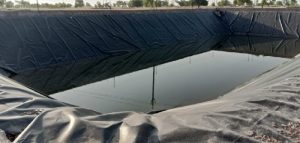 RPE vs HDPE Pond Liners: Which One Fits Your Pond?
 Landslide Protection and Slope Protection With Gabion Retaining Wall
 Kailasa Hills Project: Strengthening Infrastructure with Ocean Non Wovens’ Geosynthetics
