Enhancing Railway Infrastructure with Geosynthetics: A Case Study in Ahmednagar
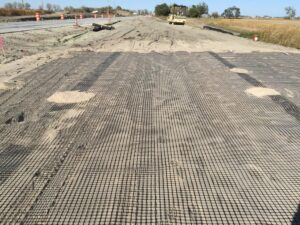
For a railway project at Ahmednagar (now Ahilyanagar), Maharashtra, Ocean Non Wovens supplied 157,200 square metres of Ocean Geotextile and 129,055.25 square metres of Ocean Geogrid-30Kn. The project modernised and expanded the existing rail network in the region, and the two materials were used together in track bed stabilisation, embankment reinforcement and soil erosion control.
Project Overview
- Location: Ahmednagar, Maharashtra
- Scope: track bed stabilisation, embankment reinforcement and erosion control on a rail modernisation and expansion project
- Products: Ocean Geotextile, 157,200 sq m; Ocean Geogrid-30Kn, 129,055.25 sq m
Challenges
The soils along the route were prone to erosion, which put the stability of the track formation and embankments at risk. The Ahmednagar region lies on the Deccan basalt plateau, where weathered rock is often overlain by black cotton soil and other fine-grained soils that soften when wet and wash out of unprotected slopes in the monsoon. The materials also had to carry heavy, repeated train loads and keep performing through wet and dry seasons.
Solution
Ocean Non Wovens supplied a geotextile and a geogrid, which do different jobs in a rail formation. The geotextile keeps soil layers apart and lets water out; the geogrid reinforces the granular layers and embankment fill.
Ocean Geotextile
The 157,200 square metres of Ocean Geotextile were used across the site for separation, filtration and drainage.
- Separation: laid between the subgrade and the blanket or sub-ballast, it stops fine soil pumping up into the granular layers under repeated train loads and stops stone being pushed down into soft soil. Fouled sub-ballast drains poorly and loses strength, which is a common cause of track geometry problems.
- Filtration and drainage: water passes through the fabric and away, while soil particles stay behind, so the formation drains without losing fines.
- Erosion control: on embankment slopes, the geotextile holds soil in place beneath the cover layer while letting seepage escape.
Keeping the subgrade intact and drained means the track holds its alignment longer and needs less maintenance.
Ocean Geogrid-30Kn
The 129,055.25 square metres of Ocean Geogrid-30Kn reinforced the embankments and subgrade. A 30 kN geogrid has a tensile strength of 30 kN per metre width. Aggregate and compacted fill interlock with its apertures, so the grid takes up tension and resists the sideways spreading of soil and stone under load. In practice that means:
- Less soil movement and settlement in the embankment
- Less rutting and deformation of the formation
- Higher bearing capacity for the track above
- A longer service life with less maintenance
Benefits
- Durability: a separated, reinforced formation is less prone to premature failure.
- Stability: stabilising the track bed and embankments improves operational safety and reliability, even on difficult soils.
- Cost: lower maintenance and a longer service life reduce costs over the life of the line.
- Material savings: reinforcement and separation can reduce the quantity of imported granular material and the earthwork needed.
Ocean Non Wovens supplies geotextiles, geogrids and other geosynthetics for railway formation, embankment and erosion control work across India. More rail projects are on our case studies page.

source on Google
 Football Project: How Ocean Non Wovens’ 120 GSM Nonwoven Geotextile Delivered a Durable, Drainage-Ready Field in Mumbai
 How Ocean Non-Wovens Biaxial Geogrid helped ensure the success of a construction project in Bhubaneswar, Odisha
 Slope and Drainage Protection Using GCCM in Jaipur, Rajasthan