Geo-Tubes as Sea Walls to check Coastal Erosion in Andhra Pradesh

Coastal erosion on the Andhra Pradesh coast is driven by waves, cyclones and changes in sediment supply, and made worse by human activity along the shore. This post looks at how geosynthetics, in the form of geo tubes, have been used as sea walls to check that erosion, and what happened at Uppada.
Ocean Geosynthetics manufactures geo tubes for coastal and riverbank protection.
Andhra Pradesh has the second-longest coastline in India, at around 974 km. Before the 2022 district reorganisation, nine districts lay along the coast: Nellore, Prakasam, Guntur, Krishna, West Godavari, East Godavari, Visakhapatnam, Vizianagaram and Srikakulam, with Srikakulam having the longest shoreline.
A 2015 GIS analysis found that 275 km of the shoreline faced erosion and only 153 km was stable. The village of Uppada (East Godavari district), in the Kakinada division, is one of the worst affected. Researchers at the Andhra Pradesh Space Applications Centre estimated that the Uppada coastline eroded at an average of 1.23 m/year between 1989 and 2018.
Geo Tubes as Sea Walls:
In 2010, geotextile tubes and bags were installed along 1463 m of the Uppada seashore to protect the village, in a project led by IIT Madras. Geo tubes are widely used in river, flood and coastal shoreline protection work.
Geo tubes, or geotextile tubes, are very large tubes fabricated from high-strength woven geotextile. Local sand or soil is mixed with water and pumped into the prefabricated tube through filling ports. As the water drains out through the fabric, the sand stays behind and forms a large, continuous mass that acts as a sea wall and resists currents and waves.
Used as a sea wall, sand-filled geo tubes of synthetic (typically polypropylene or polyester) geotextile are placed parallel to the shoreline. They absorb the energy of incoming waves at high tide and reduce the erosion behind them.
At Uppada, the geo tube sea wall on the Kakinada-Uppada stretch initially reduced the erosion rate considerably. From around 2015, however, erosion resumed on the same stretch, the tubes were damaged in 2017 and 2018, and cyclones in 2016 (Vardah) and 2019 (Fani) damaged the Kakinada-Uppada beach road.
The Uppada experience shows both sides of the technique. Geo tubes can protect an unstable, dynamic coastline for several years, but where wave patterns and sediment transport keep changing and cyclones are frequent, they need monitoring, maintenance and, often, a combined design.
That is the approach now proposed. After a study of the Uppada beach profile and the strength of the waves, the state’s Transport, Roads and Buildings Department has proposed rebuilding the 1463 meter long sea wall with five layers: geotextiles, geo tubes, sand, a stone belt and a concrete layer, to a height of 6 meters.
Ocean Geosynthetics manufactures geo tubes that can be stacked in different configurations, to reinforce existing sea walls or replace them. See our shoreline protection geosynthetic products to find the right one for your project.

source on Google
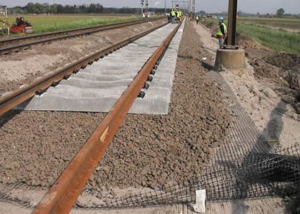 Application of Ocean Geogrids in Railways
 Ocean Geonet Geocomposite for an RVNL Project in Vasco da Gama, Goa
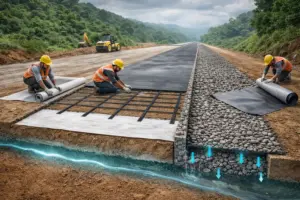 Multi-Geosynthetic Highway Project