Riverbank Protection and Irrigation Stability Using Ocean Non Woven Geobag (PP) 300 GSM in Howrah, West Bengal
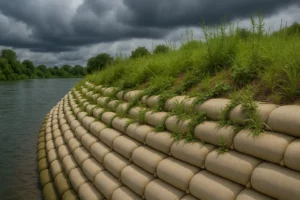
For an irrigation project in Howrah, West Bengal, Ocean Non Wovens supplied 27,000 Nos. of Ocean Non Woven Geobag (PP) 300 GSM for erosion control and embankment stabilization. The bags armour the embankments that carry and contain irrigation water, in a district where soft alluvial soil, heavy monsoon rain and tidal river levels wear banks down year after year.
Project overview
- Project Type: Irrigation and Riverbank Protection Project
- Location: Howrah, West Bengal
- Product Used: Ocean Non Woven Geobag (PP) 300 GSM
- Quantity: 27,000 Nos.
- Application Area: Erosion control and embankment stabilization
Why irrigation embankments erode in Howrah
Howrah lies on the west bank of the Hooghly, where river levels rise and fall with the tide as well as with the monsoon. In irrigation networks here, an embankment that fails does more than lose soil: it disrupts water distribution, floods or starves nearby farmland, and sends sediment into channels that then need dredging. The local conditions work against bank stability:
- Soft alluvial soil conditions
- Heavy seasonal rainfall
- High sediment movement
- Continuous moisture exposure
- Fluctuating river velocities
Stone pitching and concrete are still common responses, but stone has to be hauled into the delta from distant quarries, and rigid linings crack when the soft ground beneath them settles unevenly.
Why geobags were selected
A geobag is a container of non-woven geotextile filled with sand or soil on site and laid in layers against the bank. The 300 GSM polypropylene fabric was chosen for its strength, flexibility and ability to conform to an irregular slope.
Flexibility under hydraulic load
Concrete linings often fail when differential settlement opens cracks beneath them. Filled geobags shift slightly and re-seat as the ground moves, so the protective layer stays continuous.
Scour resistance and filtration
Properly placed bags shield the bank face from current and wave action. Because the fabric is permeable, water drains out of the embankment through the bags while the soil stays behind, which limits washout and the build-up of pore pressure after high water.
Easy transport and installation
Empty bags are light and compact, and fill material comes from nearby. That matters on narrow embankment tops and in delta areas where heavy trucks and cranes cannot reach.
Less disturbance to the site
Geobag work needs little excavation and no concrete batching, so construction disturbs less of the surrounding land and channel.
Site challenges
Fluctuating water levels
Changing water levels were one of the main operational challenges in Howrah. Rapid changes in river discharge can interrupt placement and leave partly built sections exposed.
Soft soil
Alluvial subgrades can settle locally beneath the protection if the slope is not trimmed and prepared carefully before bags are placed.
Underwater placement
Below the waterline, visibility and positioning control are limited, and misaligned bags reduce the stability of the layer above.
Fill ratio
Overfilled bags concentrate stress on the seams and can split; underfilled bags slump and move in flowing water. Consistent filling is essential.
Stitching quality
The bag is only as strong as its seams. Weak stitching fails under constant water movement, so quality control during fabrication and closing on site is critical.
Installation methodology
The installation sequence was:
- Surface preparation and grading
- Slope alignment inspection
- Geobag filling operations
- Controlled placement sequencing
- Layered arrangement for stability
- Hydraulic exposure assessment
Sequencing matters. Bags placed at random interlock poorly and are more likely to be displaced in high flows, so placement typically starts at the toe and works up the slope in staggered, overlapping courses, much like brickwork, under engineering supervision.
Long-term performance and maintenance
How long a geobag revetment lasts depends on:
- Hydraulic exposure intensity
- Soil stability
- Installation quality
- Material durability
- Maintenance practices
- Drainage conditions
Flexible protection tolerates settlement and changing flows better than rigid linings, which need crack repair and rehabilitation after the ground moves. Geobag stretches still need periodic inspection, especially after each monsoon, to find displaced bags or local scour. Repairs usually mean placing a few new bags rather than rebuilding a section.
Exposed polypropylene degrades in sunlight over time, so bags above the waterline last longest when covered with soil and vegetation or kept out of direct sun.
Environmental benefits
- Less concrete and quarried stone
- Lower transport requirements, since fill is sourced locally
- Follows the natural terrain
- Shorter construction time
- Minimal excavation
About Ocean Non Wovens
Ocean Non Wovens manufactures and supplies geosynthetics for irrigation, river engineering, landfill, infrastructure, aquaculture and environmental projects across India, with support from manufacture through supply and project execution. For geobags in other fabric weights and sizes, see the geobag range or browse more case studies.

source on Google
 Case Study: Slope Protection and Sustainable Infrastructure Development Using Ocean Geosynthetic Cementitious Composite Mat 10 MM for a Coal Mining Project in Purba Medinipur, West Bengal
 Enhancing Railway Infrastructure with Geotextiles in UP State
 Flood Control with Geobags: A Sustainable and Effective Approach
