Ocean Polymer Net on the Kohima-Jessami Road Project, Nagaland
On the Kohima-Jessami Road Project in Nagaland, Ocean Non Wovens supplied Ocean Polymer Net covering 50,100 sq m to reinforce the roadbed and protect it against erosion. This case study sets out the site challenge, the project details and how a polymer reinforcement layer helps a hill road last.
Key project details
- Project Name: Kohima-Jessami Road Project
- Location: Nagaland
- Product Used: Ocean Polymer Net
- Geotextile Area: 50,100 sq m
The challenge: building a road through Nagaland’s hills
The road runs from Kohima, the state capital, towards Jessami near the Manipur border, through steep hill terrain. Roads in this part of the North East face heavy monsoon rainfall, weak and often saturated soils, and frequent slips on cut and fill slopes. Water running across and through the roadbed carries fines away, the base loses support, and the pavement cracks and ruts. The project needed a way to keep the roadbed stable and the soil in place without adding large quantities of imported stone, which is costly to haul into hill areas.
The solution: Ocean Polymer Net
Ocean Polymer Net was chosen to improve soil stability, prevent erosion and reinforce the roadbed. It is light enough to carry and place by hand on narrow hill-road sites, yet strong enough to take the loads of construction traffic.
Reinforcing the roadbed
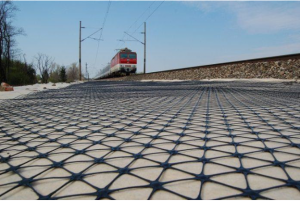
Across 50,100 sq m, the polymer net was laid as a reinforcement layer within the roadbed. A polymer net or grid works by confining the soil and aggregate placed on it: particles lock into the openings, so the layer spreads wheel loads over a wider area of subgrade and resists the lateral spreading that leads to ruts. Holding the soil together in this way also makes the road edges and embankment shoulders less prone to washing out in heavy rain.
A more stable roadbed needs fewer repairs, which matters on a hill road where every repair means hauling material over long distances and closing a route that communities depend on. Using a reinforcement layer can also reduce the thickness of aggregate needed, cutting quarrying and transport. Where the subgrade is soft and wet, engineers often add a non-woven geotextile beneath the reinforcement as a separator, so fine soil does not pump up into the aggregate.
Frequently asked questions
How does Ocean Polymer Net compare with conventional road construction?
A conventional road relies only on the thickness and quality of its granular layers. A polymer reinforcement layer confines that aggregate and spreads load over the subgrade, so the road can perform better on weak soil or reach the same performance with less aggregate. It is light and easy to handle, which speeds installation on remote sites.
Is it a more sustainable option?
It can be. A reinforced road needs fewer repairs and can use less quarried aggregate, which reduces material use and transport over the life of the road.
Can Ocean Polymer Net be used in other infrastructure projects?
Yes. Polymer nets and grids are also used in embankments, retaining walls and slope stabilisation. See our geogrids and other geosynthetics, or browse more case studies.
Ocean Non Wovens Pvt. Ltd
Manufacturer, supplier and exporter of geomembranes and geosynthetics
RR-24, 2nd floor, Rohtak Rd, Mianwali Nagar, New Delhi, 110087
Tel: +91 8447226007 | Email: sales@oceangeosynthetics.com

source on Google
 Biofloc Fish Farming
 Geosynthetics Products for Ground Performance Improvement
 How Geobags and Gabions Can Be Used to Control Floods and Prevent River Erosion in Assam