River Bank Protection Project: Ocean Non Wovens Delivers with Gabion Boxes
Introduction
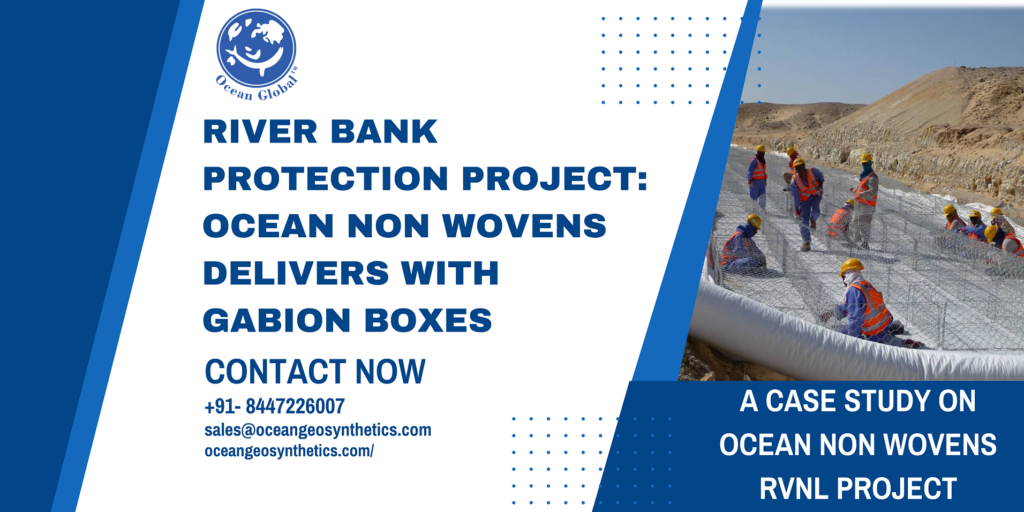
For a River Bank Protection Project in Sitamarhi, Bihar, Ocean Non Wovens supplied 3330 Gabion Boxes to protect eroding river banks.
Sitamarhi lies in north Bihar, on the plains crossed by rivers such as the Bagmati that flow down from Nepal. These rivers rise quickly in the monsoon, carry heavy sediment loads and shift their channels, so bank erosion costs land, damages property and threatens embankments and villages. Ocean Non Wovens worked with local authorities on the project and proposed Gabion Boxes for the bank protection.
What gabion boxes are
Gabion boxes are wire mesh containers filled on site with stone. Stacked and wired together, they form a heavy, flexible facing used for erosion control, retaining walls and slope stabilisation. For river works they are usually made from double-twisted hexagonal steel wire mesh, galvanised and often PVC-coated for corrosion protection. In India, IS 16014 is the specification for mechanically woven, double-twisted hexagonal wire mesh gabions and mattresses.
Why gabions suit river bank protection
- Weight: a stone-filled box is heavy enough to resist being moved by river flow.
- Permeability: water passes through the stone fill, so pressure does not build up behind the wall. The rough, open face also dissipates the energy of the flow instead of reflecting it.
- Flexibility: the wire mesh lets the structure deform and settle with the bank without cracking, unlike rigid concrete.
- Local materials: the boxes are delivered flat and filled with stone sourced near the site.
On this project, Ocean Non Wovens combined Gabion Boxes with an anchoring system to protect the banks. The gabions take the energy of the flow and stop further loss of bank material.
Design points for gabion bank protection
Gabion protection depends on a few details:
- Toe protection: most bank failures start with scour at the toe. Gabion mattresses or a launching apron at the base are normally provided so the structure is not undermined.
- Filter layer: a non-woven geotextile placed behind and beneath the gabions stops fine bank soil washing out through the stone.
- Stone fill: stones should be hard, durable and larger than the mesh opening, packed tightly to keep voids small.
- Lacing and bracing: boxes are laced to each other with binding wire, and internal bracing wires keep the faces from bulging as they are filled.
Frequently asked questions
Are gabion boxes environmentally friendly?
Gabions use natural stone and steel wire, and their open structure lets water through. Over time, sediment and vegetation settle into the voids, so the structure blends into the bank more than concrete does.
How long do gabion boxes last?
Life depends mostly on the wire’s corrosion protection and on abrasion from sediment-laden flow. With galvanised or PVC-coated wire, proper installation and maintenance, gabions can last for several decades.
Can gabion boxes be customised for a project?
Yes. Ocean Non Wovens supplies gabion boxes in sizes and mesh specifications to suit each project, and works with the project team on the requirements.
About Ocean Non Wovens
The Sitamarhi project used 3330 Gabion Boxes to protect the river banks and stabilise the area. Ocean Non Wovens manufactures and supplies gabions and geosynthetics for erosion control. Contact the team to discuss a river protection project, or see more case studies.

source on Google
 Steel Plant Project at Sambalpur – Case Study
 Case Study: Environmental Containment and Oil Pit Protection Using Ocean HDPE Liner 1.5 MM at an Oil Pit Reservoir Project in Assam
 Football Project: How Ocean Non Wovens’ 120 GSM Nonwoven Geotextile Delivered a Durable, Drainage-Ready Field in Mumbai