Ocean Non Wovens’ Biaxial Geogrid for the Panipat Refinery Project
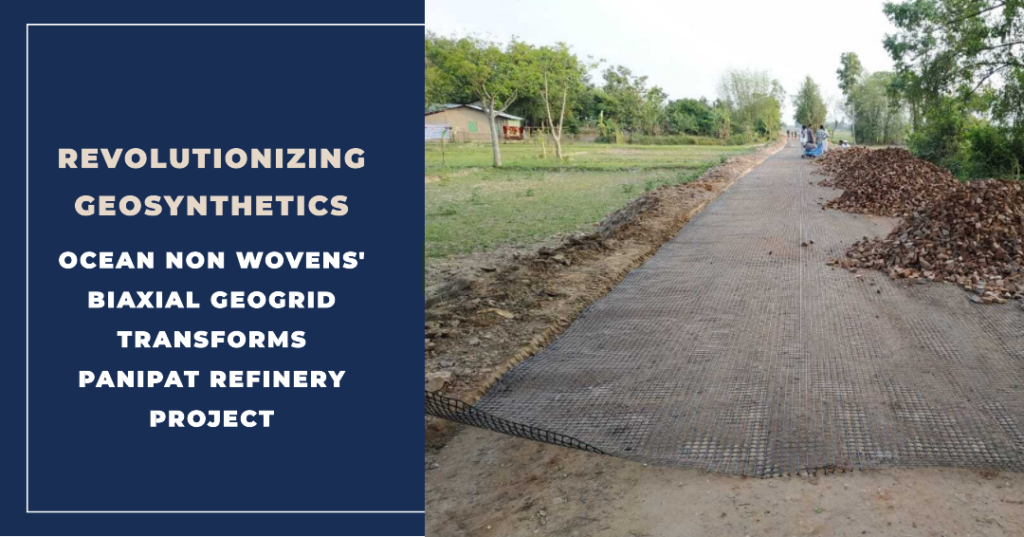
Ocean Non Wovens supplied 10,000 square metres of Biaxial Geogrid for the Panipat Refinery Project in Haryana. The project needed soil stabilisation, reinforcement and erosion control, and the geogrid was used to reinforce granular layers over the site’s soils.
Project overview
- Project: Panipat Refinery Project
- Location: Panipat, Haryana
- Product used: Ocean Non Wovens Biaxial Geogrid
- Quantity: 10,000 square metres
- Purpose: soil stabilisation, reinforcement and erosion control
How a biaxial geogrid works
A biaxial geogrid is a polymer grid with roughly equal strength in both directions of the roll. Laid under or within a layer of aggregate, it interlocks with the stone: particles settle into the apertures and press against the ribs. That interlock stops the aggregate spreading sideways under load, so the layer stays stiff, spreads load over a wider area and settles less. The result is higher bearing capacity and less differential settlement than the same aggregate laid without reinforcement.
Biaxial grids are used where loads come from many directions, such as access roads, hardstands, working platforms, embankment bases, railway formations and landfill foundations. Tensile strength is measured to ASTM D6637 or ISO 10319, and grade is chosen by the subgrade strength and traffic the layer has to carry. Retaining walls and steep reinforced slopes, where the main load acts in one direction, normally use uniaxial geogrids.
Use at the Panipat refinery
A refinery site carries heavy vehicles, cranes and plant over large areas, much of it on internal roads and working platforms. The Ocean Non Wovens team worked with project stakeholders to understand the site’s requirements and provided guidance from the start of the project through execution, so the geogrid was specified and installed correctly.
For a grid to work, it has to be laid flat and taut on a levelled subgrade, with overlaps between rolls, and aggregate spread forward from material already placed so that plant does not run on the bare grid. On soft or fine-grained subgrades, a non woven geotextile beneath the grid keeps fines out of the aggregate.
Benefits
- Load distribution: the reinforced layer spreads loads and raises bearing capacity.
- Less settlement: confined aggregate settles less and more evenly.
- Cost and time: a reinforced layer can be thinner than an unreinforced one, saving aggregate, haulage and construction time.
- Durability: polymer grids do not corrode and resist the chemicals found in soils.
Ocean Non Wovens supplies biaxial geogrids and other geosynthetics for roads, highways, railways, retaining walls, landfills and industrial sites. See more projects in our case studies.
FAQs
What advantages does a biaxial geogrid have over conventional methods?
A biaxial geogrid lets a thinner layer of aggregate do the work of a thicker unreinforced one, which saves material, haulage and time. It has high tensile strength, stays flexible and does not corrode.
Can a biaxial geogrid be matched to specific project requirements?
Yes. Biaxial geogrids come in different strengths, aperture sizes and roll dimensions. Grade selection depends on subgrade strength, aggregate size and the loads the layer has to carry. Contact Ocean Non Wovens to discuss your project.
Is a biaxial geogrid environmentally friendly?
Using a geogrid reduces the amount of quarried aggregate and excavation a project needs, which lowers haulage and the carbon footprint of construction.

source on Google
 Ocean HDPE Liner 1mm in the Waste Oil Pit Project, Durgapur, West Bengal
 Landfill Protection Using GCL
 Tuna Tekra Container Development with Ocean Non Woven Geobags
