Ocean Geotextile for a Railway Project at Satara, Maharashtra
Introduction
Ocean Non Wovens supplied 100,000 square metres of Ocean Geotextile for a railway project at Satara, Maharashtra. Like other geosynthetics in rail work, the fabric went into the track formation and embankments, where its job is to keep the subgrade and the ballast apart, help the formation drain, and support the embankment slopes. These are the three things that most often decide how long a track holds its line and level before it needs maintenance.
The railway project
Satara lies on the Pune–Miraj rail corridor in western Maharashtra, where formations are often built on black cotton soil and weathered basalt. Soils like these soften in the monsoon, and under repeated train loads soft subgrade pumps up into the ballast, fouls it and lets the track settle unevenly. The project needed a durable, dependable material to prevent this over a large area, and Ocean Non Wovens, a geotextile manufacturer, supplied Ocean Geotextile for the job.
How the geotextile was used
The project required 100,000 square metres of geotextile, used in three roles:
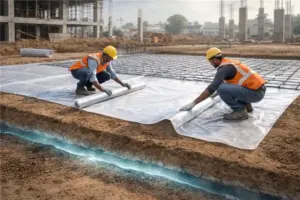
- Track stabilisation: as a separation layer between the subgrade and the ballast or blanket, Ocean Geotextile stops subgrade soil mixing into the granular layers, which keeps the track bed intact and reduces settlement.
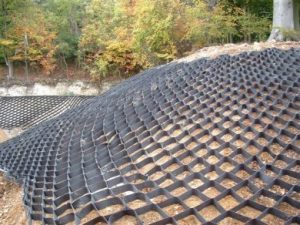
- Embankment support: on the embankments, the fabric holds soil in place on the slopes and adds some tensile restraint to the fill, which helps spread loads and limits deformation and shallow slope failures. (Where a design relies on reinforcement strength, geogrids or high-strength woven geotextiles are normally specified.)
- Drainage: water passes through and along the geotextile while soil stays behind, so moisture does not build up in the formation and weaken it.
Benefits
- Durability: a formation that stays separated and drained lasts longer between repairs.
- Load distribution: a clean, intact granular layer spreads train loads more evenly onto the subgrade, reducing stress concentrations and premature failure.
- Cost savings: less ballast cleaning, tamping and repair lowers costs over the life of the line.
For railway formations, geotextiles are normally chosen by mass per unit area, grab and puncture strength, apparent opening size and permittivity, matched to the subgrade soil and the loads. Ocean also supplies geogrids for formations that need reinforcement as well as separation, and more rail projects are on our case studies page.
FAQs
Is Ocean Geotextile suitable for various climate conditions?
Yes. Polypropylene and polyester geotextiles do not rot and are unaffected by water, heat or frost once buried. They should be covered within the exposure time the manufacturer allows, because prolonged sunlight degrades the fibres.
How does Ocean Geotextile contribute to environmental sustainability?
Separation and filtration keep granular layers clean and working for longer, so less quarried ballast and fill is needed for repairs and reconstruction. A longer service life also means fewer replacements.
Can Ocean Geotextile be customized for specific project requirements?
Yes. Ocean Non Wovens supplies geotextiles in a range of weights, thicknesses and roll sizes, and our team can help match the grade to the soil and loading on your project.
Ocean Non Wovens Pvt. Ltd
Manufacturer, Supplier & Exporter of Geomembranes & Geosynthetics
RR-24, 2nd floor, Rohtak Rd, Mianwali Nagar, New Delhi, 110087
Tel: +91 8447226007 | Email: sales@oceangeosynthetics.com

source on Google
 LDPE Liner Application in Building Construction
 Best Geocell Sellers in North East India