How Geosynthetics Are Used in Delhi-Mumbai Expressway Construction
The Delhi-Mumbai Expressway is the most ambitious road India has ever attempted. Stretching around 1,350 kilometres across six states at a cost of roughly one lakh crore rupees, it is the longest greenfield expressway in the country and one of the largest in the world. When it is fully open, a journey that once took close to a full day will fall to around twelve hours. Yet behind the smooth eight-lane ribbon and the record-setting pace of construction sits a technology most drivers will never see or think about. Geosynthetics, the engineered grids, fabrics, cells and membranes that reinforce and protect the ground, are woven through this expressway from its towering interchange walls to its rain-battered embankment slopes. This article looks at how geosynthetics are used on the Delhi-Mumbai Expressway, and why they have become indispensable to building infrastructure at this scale.
Project Overview: A Corridor Built for the Future
The Delhi-Mumbai Expressway is a greenfield alignment, meaning it was cut through new ground rather than widened from an existing road. That freedom let planners design for speed and efficiency from the first survey line, with gentle gradients, wide medians, and grade separations that keep traffic flowing without interruption. It passes through Haryana, Rajasthan, Madhya Pradesh, Gujarat and Maharashtra, linking the national capital region to the country’s financial capital and connecting dozens of economic centres along the way. Several sections are already operational, with further stretches opening through 2026.
A project of this length crosses almost every ground condition India can offer, from the arid soils of Rajasthan to the black-cotton clays of Madhya Pradesh and the high-rainfall terrain approaching the Western Ghats. Building a durable, high-speed carriageway across all of that, on a tight national timeline, is precisely the kind of challenge geosynthetics were invented to solve. They let engineers build stronger structures faster, with less imported material and a far smaller environmental footprint.
Why Geosynthetics Are Central to Expressway Construction
An expressway is not simply a wider highway. Its speed and its grade separations demand steep embankments, tall retaining structures, long approach ramps and slopes that must remain stable for decades under heavy dynamic loading. Doing all of that with traditional reinforced concrete and imported aggregate would be slow, expensive and carbon-intensive. Geosynthetics change the economics. By reinforcing soil so it can stand steeper and carry more, by separating and draining weak ground, and by confining slopes against erosion, they replace bulk concrete and steel with engineered fill and lightweight polymer.
Indian design practice supports this at every step. The Indian Roads Congress guideline IRC:SP:59 governs the use of geosynthetics in road pavements, IRC:113 covers reinforced embankments on soft soils, and the MoRTH Specifications for Road and Bridge Works set out the material and construction requirements. International standards from the International Geosynthetics Society (IGS), the Geosynthetic Institute (GSI), the FHWA and ASTM provide the testing framework. On a corridor as demanding as the Delhi-Mumbai Expressway, these materials are not optional extras. They are core structural elements.
Retaining Wall Case Study: The Geosynthetic Reinforced Earth Wall
Nowhere is the role of geosynthetics more visible than in the expressway’s retaining walls. Every interchange, flyover approach, vehicular underpass and elevated ramp needs earth to be held back at a steep face, and on the Delhi-Mumbai Expressway a large share of that work is done with the geosynthetic reinforced earth wall rather than conventional reinforced cement concrete.
The principle is elegant. Soil is strong in compression but weak in tension, so layers of high-strength geogrid are laid horizontally within compacted engineered fill at regular vertical spacings. The geogrid grips the soil and supplies the tensile strength it lacks, turning the fill and reinforcement into a single coherent mass that behaves like a gravity wall. That mass is then finished with a facing, whether precast concrete panels, modular blocks or a vegetated fascia, giving a clean vertical or near-vertical face. A geogrid retaining wall on an expressway can rise many metres, carry the surcharge of live traffic, and still tolerate the minor ground movements that would crack a rigid concrete wall.
The Delhi-Mumbai Expressway has used geosynthetic reinforced soil wall systems across tens of kilometres of its structures, with reinforced soil wall products such as StrataWall illustrating just how central this technology has become to modern expressway construction. The advantages are compelling. A geogrid retaining wall expressway structure is faster to build than a cast concrete wall because it rises in compacted lifts rather than waiting on formwork and curing. It uses far less cement and steel. It flexes with differential settlement instead of cracking. And it can be built with locally available fill, cutting both cost and haulage. For a project racing to open on schedule, reinforced soil walls remove one of the slowest, most material-hungry items from the critical path.
Erosion Control: Geocells on Expressway Slopes
The second highly visible use of geosynthetics on the Delhi-Mumbai Expressway is slope protection. A high-speed corridor with tall embankments and deep cuttings exposes enormous areas of bare soil to the monsoon, and unprotected slopes erode, gully and eventually slump, threatening the carriageway and blocking drains. The answer is the geocell, and understanding the geocell material is key to understanding why it works so well.
A geocell is a three-dimensional honeycomb of high-density polyethylene strips, ultrasonically welded so that when the panel is stretched open it forms a network of interconnected cells. Pinned to a prepared slope and filled with soil, aggregate or topsoil, the geocell confines the surface material inside its walls so that rain and runoff cannot wash it away. This cellular confinement holds the slope face in place, retains moisture and nutrients so vegetation can establish, and spreads any load across a flexible mattress. The result is genuine geocell erosion control highway performance, keeping embankment and cut slopes stable through successive monsoons with a fraction of the maintenance that unprotected or hard-armoured slopes require.
On the Delhi-Mumbai Expressway, geocells are used to green and stabilise embankment faces, to armour channel and drain linings against scour, and, when filled with aggregate or concrete, to provide load support over weak ground. Because the confined layer behaves as a semi-rigid mattress, the same geocell technology that protects a slope can also reinforce a road base, extending its value well beyond erosion control alone.
Separation and Filtration: Geotextiles Beneath the Pavement
Not every geosynthetic on the expressway is dramatic. Some of the most important work happens invisibly, in a thin fabric layer between the subgrade and the pavement. A geotextile separation layer stops soft subgrade soil from pumping up into the expensive granular base and stops the aggregate from punching down into the soil. Without it, the two layers intermix under traffic, the base loses strength, and the pavement fails long before its design life.
The same geotextile also filters and drains, letting water escape while holding soil particles back, which relieves the pore-water pressure that undermines shoulders and softens subgrades. Across the flood-prone and high-rainfall stretches of the Delhi-Mumbai Expressway, this quiet layer of separation and drainage is what keeps the pavement structure intact season after season. Woven and non-woven geotextiles are specified by opening size, permittivity and tensile strength to ASTM and IRC standards, and matched to the soil they protect.
Geomembranes at Water Crossings
Where the expressway runs alongside or across water bodies, canals and stormwater channels, geomembranes come into play. An HDPE geomembrane is a continuous impermeable sheet that prevents water from seeping into and softening the road structure, and prevents contaminated runoff from reaching groundwater. Used to line channels, protect embankment cores and waterproof crossings, geomembranes keep water where it belongs and out of the ground that supports the carriageway. Their impermeability and durability are governed by GRI-GM13 from the Geosynthetic Institute and IS 16352 from the Bureau of Indian Standards.
Carbon Savings: The Sustainability Case
The environmental argument for geosynthetics on the Delhi-Mumbai Expressway is as strong as the engineering one, and on a project of this scale the numbers are large. A geosynthetic reinforced earth wall replaces the enormous quantities of cement and steel that a conventional reinforced concrete retaining wall consumes, and cement and steel are two of the most carbon-intensive materials in all of construction. Independent life-cycle assessments of reinforced soil walls against concrete cantilever walls consistently show a substantial reduction in embodied carbon, often a large fraction of the total, because the reinforced soil structure relies mainly on compacted local fill and a modest weight of polymer reinforcement.
The savings compound across the corridor. Using geogrids to reduce aggregate thickness cuts the volume of quarried stone that must be mined and hauled. Building walls and slopes from local fill rather than imported concrete slashes transport movements and the diesel that goes with them. Faster construction shortens the period of site emissions and gets the corridor into service sooner. And because reinforced soil structures and geocell-protected slopes are flexible and self-healing, they need less repair and reconstruction over their life, avoiding the repeated carbon cost of maintenance. For a nation building tens of thousands of kilometres of new highway, adopting geosynthetics is one of the most effective ways to hold down the carbon footprint of that growth.
Product Specifications at a Glance
The table below sets out the main geosynthetic products used on a corridor like the Delhi-Mumbai Expressway, with representative properties and the standards that govern them.
| Product | Type | Key Property | Typical Specification | Reference Standard | Primary Application |
|---|---|---|---|---|---|
| Uniaxial Geogrid | PET or HDPE geogrid | Ultimate tensile strength | 50 to 400 kN/m | ASTM D6637, IRC:SP:59 | Reinforced earth walls, steep slopes |
| Biaxial Geogrid | PP geogrid | Aperture stability, tensile strength | 20 to 40 kN/m | ASTM D6637 | Subgrade and base stabilisation |
| HDPE Geocell | Cellular confinement | Cell depth, seam peel strength | 75 to 200 mm depth | ASTM D5397, GRI-GS10 | Slope erosion control, load support |
| Non-woven Geotextile | Needle-punched PP | Mass per unit area, permittivity | 150 to 400 gsm | ASTM D4751, D4491 | Separation, filtration, drainage |
| Woven Geotextile | PP or PET | Wide-width tensile strength | 40 to 200 kN/m | ASTM D4595, D4632 | Basal reinforcement, separation |
| HDPE Geomembrane | Impermeable liner | Thickness, low permeability | 0.5 to 2.0 mm | GRI-GM13, IS 16352 | Water crossings, channel lining |
The exact grade selected for any location depends on the wall height, the soil, the loading and the design life, which is why matching the product to the site is as important as the product itself.
Why Ocean Non Wovens for Expressway Projects
Delivering geosynthetics for a corridor the size of the Delhi-Mumbai Expressway demands a manufacturer who can combine engineering quality with dependable, high-volume supply, and that is exactly where Ocean Non Wovens fits. As a leading Indian manufacturer and supplier of geogrids, woven and non-woven geotextiles, geocells, HDPE liners and geobags, Ocean Non Wovens produces materials tested to Indian and international specifications and delivered on the timelines that major expressway packages require.
Ocean Non Wovens supports reinforced soil walls and steep slopes, subgrade and base stabilisation, slope protection and erosion control, drainage and water crossings, along with defence infrastructure, airports, railways, water resources and industrial developments across the country. For the contractors and consultants building India’s expressway network, that means a single, reliable source for the full range of geosynthetics a modern high-speed corridor needs, backed by technical support to help specify the right product for every ground condition and structure. If your project involves a geogrid retaining wall, geocell erosion control, geosynthetic reinforced earth wall design, separation, drainage or water crossings, Ocean Non Wovens can help you build stronger, greener infrastructure that opens on time and lasts for decades. Talk to Ocean Non Wovens and put engineered ground beneath India’s next landmark expressway.

source on Google
 The role of Geocells for Soil Stabilization
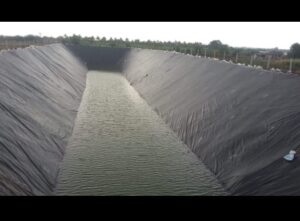 Canal Work Project at IGI Airport, Delhi
 River Bank Protection Project: Ocean Non Wovens Delivers with Gabion Boxes