Polypropylene Geogrid

Polypropylene (PP) geogrid is the standard grid for reinforcing road bases and stabilising soft subgrades. Ocean Geosynthetics manufactures biaxial PP geogrids in three strengths, 20, 30 and 40 kN/m, each with a standard and a larger-aperture version. This page covers what PP brings as a polymer, the grades, where PP fits and where another polymer is the better choice. For an overview of all geogrid types, see the main geogrid page.
What is polypropylene geogrid?
A PP geogrid is a polypropylene grid with open apertures, laid in soil or aggregate. Particles lock into the apertures, and the grid restrains them from moving sideways under load. The reinforced layer stays stiffer and spreads load over a wider area of the soil below, which reduces rutting and settlement.
Properties of polypropylene as a geogrid polymer
- Chemical resistance: PP resists acids, alkalis and salts across a wide pH range, so it can be used in lime- or cement-treated soils and alkaline fills where polyester is not recommended.
- Biological resistance: it does not rot, unlike natural-fibre products such as jute or coir.
- UV: PP geogrids are stabilised with carbon black to tolerate exposure during handling and installation. They are designed to be buried, not left exposed.
- Light weight: PP has a density of about 0.90 to 0.91 g/cm³, so rolls are light and easy to handle on site, which helps on remote rural road works.
- Creep: PP creeps more than polyester under sustained load. FHWA default creep reduction factors are about 4.0 to 5.0 for PP against roughly 1.4 to 2.5 for polyester. This matters little in road bases, where loads are short and repeated, but it rules PP out of most high, permanent retaining walls.
Ocean PP geogrid grades
| Grade | Ultimate strength MD/CD (kN/m) | At 2% strain (kN/m) | At 5% strain (kN/m) | Aperture (mm) |
|---|---|---|---|---|
| OG/GG PP-2020 / 2020L | 20 | 7.0 | 15 | 38 / 60 |
| OG/GG PP-3030 / 3030L | 30 | 10.0 | 20 | 38 / 60 |
| OG/GG PP-4040 / 4040L | 40 | 14.0 | 28 | 30 / 60 |
Tensile properties are tested to ASTM D6637 and EN ISO 10319. Rolls are 100 m long and 5.0 m wide (5.1 m for the 4040 grades). Ocean tests its PP geogrids for tensile strength, elongation, UV stability and chemical resistance. Full data is in the specification table on the geogrid page and in the PP geogrid brochure (PDF). Geogrids for flexible pavements in India must comply with IS 17371:2020.
Applications
Road construction and pavement reinforcement
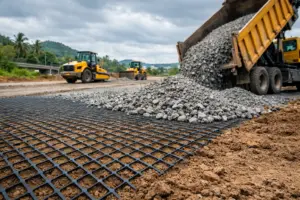
The main use. PP grid at the base of the granular layer stabilises the subgrade and reduces rutting, or allows a thinner base for the same traffic. Design follows IRC:SP:59-2019, using the Layer Coefficient Ratio or Modulus Improvement Factor with IRC:37.
Foundations, yards and working platforms
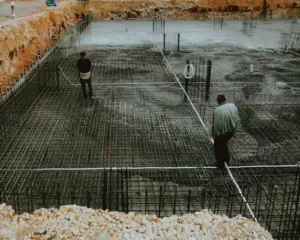
Under industrial yards, driveways, parking areas, crane and piling platforms, and granular rafts below light buildings, the grid spreads load and reduces differential settlement.
Slopes and embankments
Layers of grid hold fill and cover soil together on embankment slopes, reducing shallow slips and soil movement in high-rainfall areas. Surface erosion still needs a cover such as an erosion control mat or vegetation.
Landfills
PP grids stabilise the cover soil on landfill caps and reinforce the base over soft or variable ground. They are not a liner or drainage layer: leachate containment needs a geomembrane, and drainage needs a geonet or geocomposite.
Retaining walls
Biaxial PP grids are used for secondary reinforcement, facing wraps and low landscape walls. For the primary reinforcement of permanent reinforced soil walls, uniaxial HDPE or polyester grids are normally specified because of their lower creep.
Choosing a PP geogrid grade
- Subgrade strength: the softer the subgrade, the higher the grade. Very soft ground may also need a separation geotextile.
- Low-strain stiffness: compare the 2% and 5% strain values, since the grid works at small strains in a base.
- Fill grading: use the standard apertures for finer granular bases and the L grades (60 mm) for coarser fill, so particles interlock with the ribs.
- Design life under sustained load: if the grid will carry permanent tension, check long-term design strength or move to polyester.
Installation basics
Level the formation and remove sharp objects. Unroll the grid, pull it taut and overlap rolls as the design requires. Tip aggregate at the edge of the placed fill and spread it forward; keep tracked plant off the bare grid and maintain at least the designed minimum cover before compaction. Store rolls covered and off the ground.
Frequently asked questions
Is a PP geogrid the same as a biaxial geogrid?
Not exactly. PP describes the polymer; biaxial describes strength in both directions. Ocean’s PP grids are biaxial, and Ocean also makes biaxial geogrids in polyester for higher strengths.
What does the L in PP-2020L mean?
The L grades have a larger aperture (60 mm instead of 38 mm or 30 mm) at the same strength, for coarser fill.
Can PP geogrid be used with lime- or cement-stabilised soil?
Yes. PP tolerates the high pH of these soils, which can degrade polyester.
Which grade is used most for rural roads?
It depends on subgrade CBR and traffic, worked out in the IRC:SP:59 design. Send us the CBR, traffic and aggregate details and we will suggest a grade.