PVC Geo Pipes
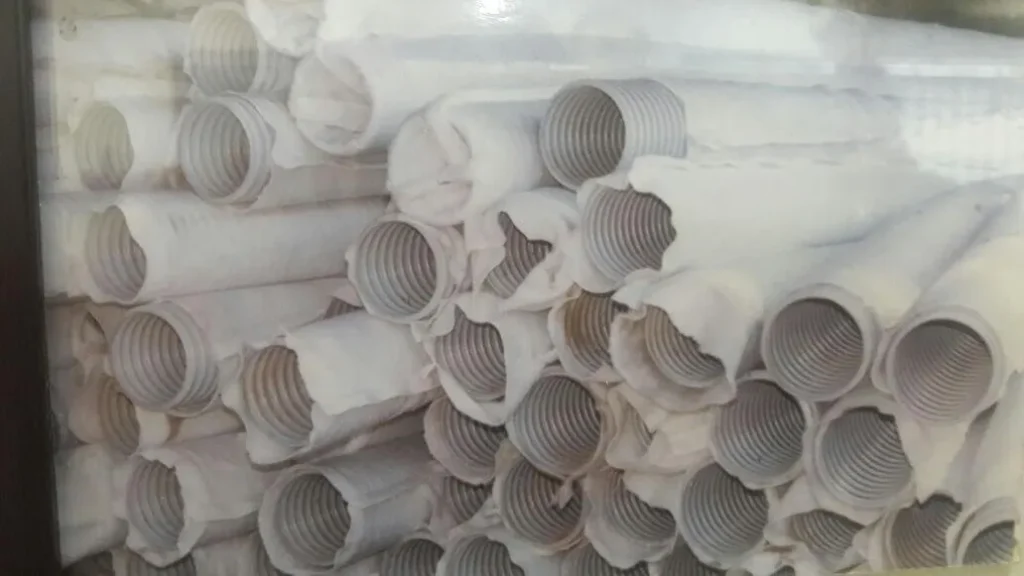
Ocean Geosynthetics manufactures PVC geo pipes (geopipes): plastic pipes used for subsurface drainage in roads, railways, retaining walls, landfills, sports fields and farmland. Perforated pipe, laid in a gravel trench and wrapped in geotextile, collects groundwater and seepage and carries it away before it can soften the subgrade or build up pressure behind a wall.
Table of Contents
What are geopipes?
Buried plastic pipe was arguably the first geosynthetic, and in geotechnical work it is called geopipe. In the geosynthetics field two types dominate: PVC and HDPE, either as smooth-wall pipe or as corrugated drainage pipe. For drainage, the pipe is perforated or slotted so water can enter along its length.
Plastic pipe in general is also used for water and gas distribution, sewers and wastewater, oil and gas production, industrial and mining pipelines, power and communication ducts, and irrigation. This page covers geopipe for drainage, which is Ocean’s main function for this product: subsurface drainage, both horizontal and vertical.
How a geopipe drain works
A typical subsurface drain has three parts:
- Perforated pipe at the bottom of a trench, laid to a fall, which carries collected water to an outlet, manhole or side drain.
- Filter aggregate (clean gravel or crushed stone) around the pipe, which gives water an easy path to the perforations.
- Filter geotextile, either lining the trench and wrapping the aggregate or wrapped directly around the pipe as a sock. It lets water through but holds back soil fines that would otherwise wash into the pipe and clog it.
In fine or sandy soils a filter is needed; without one, soil particles migrate through the perforations and the drain silts up.
What are geopipes made of?
Pipelines for water, gas, oil and other liquids have traditionally been made of steel, iron, concrete or clay. These are classed as rigid pipes. Pipes made from polymers such as PVC and HDPE are classed as flexible pipes: they carry load partly by deflecting slightly and mobilising support from the surrounding soil, which is why bedding and backfill quality matter as much as the pipe itself.
Corrugated walls give a plastic drainage pipe high ring stiffness (crush resistance) for its weight, and some corrugated pipes are flexible enough to be supplied in coils. In India, unplasticised PVC single-wall corrugated drainage pipe is covered by IS 9271, which includes both perforated and non-perforated pipe for sub-surface drainage of farms, canals, highways, roads and building foundations.
Benefits of geopipe drains
- Durable: PVC and HDPE do not rust or rot and resist most chemicals found in soil and groundwater. Correctly installed plastic drainage pipe can serve for several decades underground with little maintenance.
- High crush strength: the corrugated profile resists soil and traffic loads for its weight.
- Weather and corrosion resistant: unaffected by acidic or saline soils that attack metal and concrete.
- Light and quick to install: easy to carry, lay and store; long lengths mean fewer joints and faster laying than concrete or clay pipe.
- Cost-effective: usually cheaper to supply and install than traditional rubble or stone-filled French drains of the same capacity.
- Efficient drainage: smooth inner surfaces and continuous perforations collect and move water steadily.
- Protected against clogging: a geotextile wrap keeps fines out of the pipe.
Applications
Sectors: industries, agriculture, transportation, drainage, civic and landscaping, slopes and walls, ports, building and water.
- Roads and highways: longitudinal edge drains and transverse drains that lower the water table under the pavement and drain the sub-base.
- Railways and airports: edge drains and seepage drains alongside formation and runways.
- Retaining walls and basements: a perforated pipe at the heel of the wall, behind the drainage layer, relieves water pressure.
- Landfills: leachate collection pipes in the drainage layer above the liner.
- Sports and recreational fields: herringbone or grid drain layouts under turf.
- Agriculture: subsurface drainage of waterlogged or saline farmland.
- Slopes and embankments: horizontal drains and pore water drains that lower water pressure in the slope.
- Mines and industrial sites: drainage of tailings areas and pad foundations.
How to specify a geopipe drain
- Diameter: sized from the expected inflow and the fall available. Use the drain spacing and depth from the drainage design.
- Stiffness: choose a stiffness class suited to the depth of cover and whether traffic passes over the pipe.
- Perforation: fully perforated pipe for collection; unperforated pipe for the outlet runs that carry water away.
- Filter: select a nonwoven geotextile whose opening size suits the surrounding soil, or a pre-wrapped pipe.
- Standards: IS 9271 for UPVC corrugated drainage pipe; for roads, MoRTH Specifications for Road and Bridge Works (Section 309, surface and sub-surface drains) and IRC:SP:42 (guidelines on road drainage).
Installation basics
- Excavate the trench to line and a uniform fall towards the outlet.
- Line the trench with filter geotextile, leaving enough width to wrap over the top.
- Place a bedding layer of filter aggregate, then lay the pipe on it. Join lengths with couplers.
- Fill around and over the pipe with aggregate, placed in layers without disturbing the pipe’s line.
- Fold the geotextile over the aggregate with an overlap, then backfill and compact.
- Provide rodding eyes or inspection chambers at intervals and at changes of direction so the drain can be flushed.
Related products
- Geotextiles for trench lining and pipe wraps
- Geocomposites and drainage cells for drainage layers behind walls and under landscaping, which discharge into a geopipe
- Dimple drain board for basement and wall drainage
Frequently asked questions
What is a geopipe?
A plastic pipe, usually PVC or HDPE, used in geotechnical and civil works. For drainage it is perforated and laid in a gravel trench, usually with a geotextile filter.
Do perforated drain pipes need a geotextile wrap?
In most soils, yes. Fine sands, silts and clays will wash into an unprotected pipe. A geotextile around the trench or the pipe acts as the filter.
PVC or HDPE drainage pipe?
Both work. PVC is stiffer; HDPE is more flexible and impact resistant, especially in cold conditions. The choice usually comes down to the specification, cover depth and availability.
Which Indian standard covers PVC drainage pipe?
IS 9271 covers unplasticised PVC single-wall corrugated pipes for drainage, both perforated and non-perforated.
What sizes do you supply?
Send us the application, length and design flow, and we will confirm available diameters, stiffness and pricing. Contact us.


Related Case Studies