Case Study: Effective Waterproofing with Dimple Board in Chikhali, Pune
Introduction
For a below-ground commercial structure in Chikhali, Pune, Ocean Non Wovens supplied and installed 12,972 Sqm of Dimple Board as part of the waterproofing system. The site had a high groundwater table, and a waterproofing membrane on its own was not enough to deal with the water pressure and moisture against the basement walls. The dimple board was added over the membrane to drain water away and protect the membrane from backfill. Ocean Non Wovens manufactures and supplies geosynthetics, including drainage boards, for projects like this.
Why below-ground structures need drainage as well as waterproofing
Waterproofing keeps water from passing through walls, floors and foundations. Below ground, water in the surrounding soil pushes against the structure, and that hydrostatic pressure forces water through any defect in the membrane. Left unchecked, moisture weakens concrete over time, corrodes reinforcement, causes mould and damages finishes. Draining water away from the wall reduces the pressure the membrane has to resist.
How a dimple board works
A dimple board, or drainage board, is a high-density polyethylene (HDPE) sheet formed with rows of raised studs. Placed against a wall, the studs create a continuous gap through which water runs down to a drain at the foot of the wall. Some boards have a filter geotextile bonded to the studs so soil cannot clog the channels. The board does four jobs:
- Drainage and moisture control: water reaching the wall drains down through the gap instead of building up against it. This matters most in basements and underground structures, where hydrostatic pressure acts on walls and foundations.
- Protection of the membrane: the board sits between the membrane and the backfill, shielding it from sharp stones, compaction equipment and impacts during construction.
- Compressive strength: the studded profile resists soil pressure, so the drainage gap stays open and point loads from backfill are spread before they reach the membrane.
- Durability: HDPE does not rot, resists most soil chemicals and is recyclable, so the board does not need replacing during the structure’s life.
Project overview: Chikhali, Pune
The project covered 12,972 Sqm of Dimple Board within a full waterproofing system for a large commercial structure built partly below ground, in an area with a high groundwater table.
Installation process
- Surface preparation: the substrate was cleaned and primed so the waterproofing membrane would bond properly and no debris would be trapped beneath it.
- Membrane application: a waterproofing membrane was applied as the primary barrier against water.
- Dimple Board placement: the board was fixed over the membrane with the dimples facing outward, so water could flow through the channels to the designated drainage points.
- Backfilling: backfill was placed and compacted carefully so the board stayed in position and undamaged.
Two details decide whether a system like this works. Board joints need to be overlapped and lapped shingle-fashion so water runs over the joint rather than into it. And the drainage gap is only useful if it connects to a working perimeter drain with an outlet; a board with nowhere to discharge simply fills up.
Dimple boards compared with coatings alone
Bituminous coatings and liquid membranes provide the barrier but no drainage and little protection. Adding a dimple board relieves water pressure against the membrane and protects it during backfilling, which is when most below-ground membranes get damaged. The boards are light, come in rolls and are quick to fix, which helps on large wall areas like those at Chikhali.
Other uses and secondary benefits
- Air gap: on the inside face of damp walls, the air gap behind the board keeps finishes away from wet masonry and adds a small amount of insulation.
- Moisture vapour: HDPE is highly resistant to water vapour, so the board, or the board combined with a vapour barrier, limits damp passing through walls and floors and helps prevent mould.
- Range of uses: the same boards are used as drainage layers on green roofs and podium decks, behind retaining walls and beneath foundation slabs.
Polythene sheet is the other common moisture barrier below ground. Our article on polythene sheet under slabs and between walls explains what the sheet does in each position and why it is not enough on its own to waterproof a basement.
Ocean Non Wovens for waterproofing and drainage
Ocean Non Wovens supplies dimple drain boards, geotextiles, geomembranes and other geosynthetics for basements, tunnels, podiums and retaining structures across India, with solutions matched to site conditions. Contact us to discuss your project, or see more case studies.

source on Google
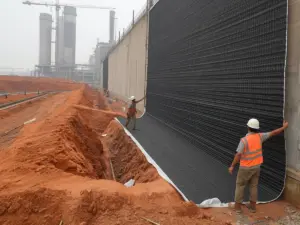 Keeping a Landmark Plant Dry: Ocean Geo Composite at the BCGCL Project, Jharsuguda, Odisha
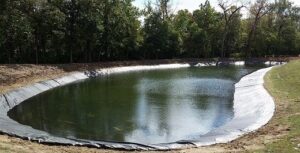 Geosynthetics for Storage of Water in Agriculture
 Case Study: Strengthening Road Infrastructure in Chittoor, Andhra Pradesh Using Geo Cells by Ocean Non Wovens