Geotextiles and Gabions for Landslide Prevention in the Char Dham Highway
The Char Dham All-Weather Road runs about 889 kilometres through the steep, fragile mountains of Uttarakhand, connecting the four shrines of Yamunotri, Gangotri, Kedarnath and Badrinath. The highway has to stay open through monsoon and snow on slopes that fail regularly, and every widening cut disturbs ground that was only marginally stable to begin with. Two groups of materials do much of the work of holding those slopes: gabions and geotextiles. This article explains how each prevents landslides on a Himalayan hill road, which standards govern them, and how to match the product to the slope.
Char Dham Project Overview
The Char Dham Mahamarg Vikas Pariyojana is the Government of India’s programme to build an all-weather, two-lane pilgrimage highway to the four Himalayan shrines of Uttarakhand. Launched in 2016 at a cost of around twelve thousand crore rupees, it widens and strengthens hill roads that carry millions of pilgrims and large volumes of freight every year, and that used to close at the first serious storm. “All-weather” is the point of the project: pilgrims, army vehicles and relief convoys must be able to reach the high valleys in any season.
That is hard to deliver. The alignment runs through some of the most landslide-prone terrain in the world, crossing deep gorges, unstable debris slopes and fractured rock along the Bhagirathi (Ganga), Yamuna, Mandakini and Alaknanda valleys. Every metre of widening cuts into a hillside, and every cut has to be held. The Ministry of Road Transport and Highways has increasingly turned to geosynthetics and gabion systems for slopes that concrete alone cannot hold economically or safely.
The Landslide Challenge in the Young Himalaya
The Himalaya is geologically young and still rising. Its rock is heavily fractured, its slopes are steep, and its soils are thin, loose and quick to saturate. Add intense monsoon rainfall, snowmelt, earthquakes and the disturbance of road cutting, and slopes are close to failure much of the time.
The failures take several forms. Debris slides carry loose soil and rock onto the carriageway. Rockfall drops boulders without warning. Slumps happen when rain saturates the ground, raises pore-water pressure and the slope moves under its own weight. Rivers erode the toe and undercut whole slopes. Freshly cut faces ravel and erode until they destabilise the ground above. A reinforced concrete retaining wall can resist some of this, but it is rigid, slow to build in remote terrain, needs cement and steel hauled up narrow roads, and cracks when the ground shifts or an earthquake hits. Slopes like these need structures that are flexible and let water out.
Why Geosynthetics and Gabions for Slope Stabilization
Current practice for slope stabilisation with geosynthetics in India treats the slope as a mass to be reinforced, drained and protected, and uses flexible structures that tolerate small movements and relieve water pressure.
A gabion is a flexible, permeable structure built from wire mesh boxes filled with stone. A geotextile is a fabric that filters, separates, drains and reinforces soil. Used together, and with geogrids and erosion control mats, they cover most of what a hill-road slope needs. Indian guidance covers each: IRC:SP:116 for the design and installation of gabion structures, IRC:56 for treating slopes for erosion control, IRC:SP:59 for geosynthetics in road works, and the MoRTH Specifications for Road and Bridge Works, with ASTM test methods and Geosynthetic Institute (GRI) specifications for material properties.
Gabion Retaining Walls for Landslide Prevention
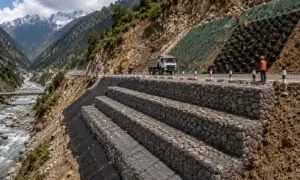
The gabion retaining wall is the most common structure in Himalayan slope protection. Each gabion is a box of double-twisted, heavily galvanised or PVC-coated steel wire mesh, filled on site with locally quarried stone and stacked in tiers to form a wall. The wall works by its weight, like a masonry gravity wall, but it is flexible and permeable.
Flexibility is why a gabion retaining wall works for landslide control. When the ground settles or shifts, or an earthquake passes through, a gabion wall deforms slightly and redistributes the load where a rigid wall would crack. Permeability matters as much. Groundwater drains straight through the stone fill, which relieves the pore-water pressure behind the wall that triggers many landslides. A concrete wall holds that water back and needs weep holes and drains to avoid being pushed over by it. Gabions also armour the toe of a slope against river erosion.
Cost is a large part of why gabions are chosen in remote terrain. They are filled with stone from close to the site, so far less cement and steel has to be hauled up mountain roads. They need no formwork, curing time or heavy plant, and can be built by hand where a concrete mixer can barely reach. A wall that tolerates movement also needs fewer repairs than one that cracks. On remote hill sites this often makes a gabion wall cheaper overall than reinforced concrete, which is why gabions appear along so much of the Char Dham route.
Landslide Prevention Geotextiles and Slope Protection
Geotextiles do less visible work. Their most important role on a slope is filtration. Behind every gabion wall and in every drainage layer, a geotextile filter is placed against the soil. Water passes through into the free-draining stone while the soil particles stay in place. Without it, a slope either builds up water pressure until it fails, or loses its fine soil through piping until it collapses.
Geotextiles also separate and reinforce. As a separator, the fabric keeps weak hillside soil out of the granular fill and drainage layers that protect the road. As reinforcement, high-strength woven geotextiles and geogrids laid in horizontal layers in a slope or embankment create a reinforced soil structure that can stand much steeper than unreinforced ground. On the cut and fill slopes of the Char Dham highway, filtration, separation and reinforcement together turn a raw cut into an engineered slope.
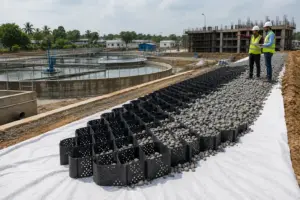
On the exposed slope face, erosion control mats and blankets hold the surface. These mats are pinned to the slope to hold topsoil, absorb the energy of rain and runoff, and protect grass and vegetation while it roots. Once established, the roots bind the surface soil. Geocells, a honeycomb confinement system, are used on steeper faces to lock infill and topsoil into their cells so the slope can be vegetated and held through the monsoon. Where loose rock overhangs the road, rockfall protection netting and barriers deal with the falling-block hazard that gabions and geotextiles do not address.
MoRTH and IRC Guidelines Driving the Change
The move to geosynthetic and gabion slope protection on Indian hill roads is backed by national guidance. MoRTH has promoted landslide mitigation and climate-resilient hill road construction, and encourages engineered soil solutions over rigid concrete where the terrain suits them. The Indian Roads Congress provides the technical detail. IRC:SP:116 covers the design and installation of gabion structures, IRC:56 the treatment of embankment and roadside slopes for erosion control, IRC:SP:59 the use of geosynthetics in road pavements and associated works, and IRC:113 geosynthetic reinforced embankments on soft subsoils. On the material side, IS 16014 specifies the double-twisted hexagonal wire mesh used for gabions, and geotextiles are tested to ASTM methods for opening size, permittivity, tensile strength and durability.
Product Specifications at a Glance
The table below summarises the main geosynthetic and gabion products used for landslide prevention on a hill highway like Char Dham, with their functions and the standards that govern them.
| Product | Function | Where Used | Key Benefit | Reference Standard |
|---|---|---|---|---|
| Gabion Box (wire mesh + stone) | Gravity retaining structure | Toe walls, retaining walls, revetments | Flexible, permeable, low cost, uses local stone | IRC:SP:116, IS 16014 |
| Woven Geotextile / Geogrid | Soil reinforcement, separation | Reinforced slopes and fill | Steeper, stronger engineered slopes | IRC:SP:59, ASTM D6637, D4595 |
| Non-woven Geotextile Filter | Filtration and drainage | Behind gabions, in drains | Relieves pore pressure, retains soil | ASTM D4751, D4491 |
| Geocell | Cellular confinement | Steep cut faces, load support | Holds infill and topsoil on steep slopes | IRC:SP:59, ASTM D5397 |
| Erosion Control Mat / Blanket | Surface erosion protection | Exposed slope faces | Holds topsoil, aids vegetation | IRC:56, ASTM D6459 |
The right grade for any location depends on the slope angle, soil, rainfall and loading, so each product has to be matched to the site.
Why Ocean Non Wovens for Slope Stabilization Projects
Ocean Non Wovens is an Indian manufacturer and supplier of geotextiles, geogrids, geocells, erosion control products, HDPE liners and geobags, along with gabion filter fabrics and allied geosynthetics, with materials tested to Indian and international specifications. Its hill-terrain work includes a landslide prevention project in Uttarakhand using rockfall barriers.
Ocean Non Wovens supplies slope stabilisation and landslide prevention, gabion and retaining wall works, reinforced soil structures, drainage and erosion control, as well as highways, expressways, defence infrastructure, railways, water resources and industrial projects across India, with technical support to specify the right product for each cut, fill and toe. If your project involves landslide prevention, gabion retaining walls, slope stabilisation geosynthetics, filtration or erosion control, talk to Ocean Non Wovens.

source on Google
Case Studies, Geocell, Geotextile
Case Study: Integrated Wastewater Management Using Ocean PP Geotextile and HDPE Geocell in Bengaluru, Karnataka Holding Back the River: How 9,000 Ocean Geobags Protected the Flood-Prone Banks at Chhapra, Bihar
 Geotextiles and Gabions for Landslide Prevention in the Char Dham Highway