Geosynthetic Reinforced Soil Walls
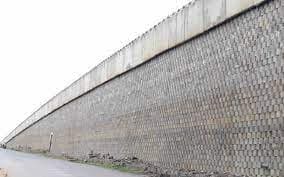
India’s highway, rail and airport programmes have made geosynthetic reinforced soil walls a common sight on flyover approaches and hill roads. In these walls, layers of geosynthetic laid in the backfill carry tension, which soil cannot, and that lets a compacted soil mass stand as a near-vertical wall.
Ocean Geosynthetics manufactures geogrid and other geosynthetics for reinforced soil walls in India.
Table of Contents
What are reinforced soil walls?
A retaining wall holds soil back laterally. Conventional retaining walls do it with a rigid concrete or masonry mass; a reinforced soil wall does it with the soil itself, strengthened by layers of reinforcement. A reinforced soil wall has a face inclined at 70 degrees or steeper (flatter faces are classed as reinforced slopes) and uses geosynthetics such as geotextiles and geo-grids to improve stiffness and stability.
Geogrids laid in the compacted backfill interlock with the soil and carry tensile load, so the reinforced block can take greater loads at steeper angles. Geogrids suit this job because of their high tensile strength, resistance to chemical and biological attack, and open apertures that lock aggregate in place.
Because they are flexible, geosynthetic reinforced soil walls tolerate more differential settlement than concrete gravity walls, which suits soft or uneven foundations. The face can be precast concrete panels, segmental blocks, gabions or a vegetated wrap-around, chosen to suit the project.
For the mechanics behind walls like these, our guide to earth reinforcement and reinforced soil covers friction and passive bearing, the IRC:SP:102 design checks and where a geomembrane does and does not belong.
Benefits of geosynthetic-reinforced soil walls:
Wall projects are usually constrained by site space, schedule, available fill and labour, long-term performance and environmental impact. Reinforced soil walls help with most of these.
Their main benefits:
- Use on-site resources and require less site preparation with minimum excavation.
- Reduced logistics
- More flexible than concrete walls, so they tolerate settlement
- Minimal maintenance
- Faster to build
- Extended service life
- Usually cheaper than reinforced concrete walls, especially as height increases, and use less concrete and steel.
- Flexible, well-drained reinforced soil walls generally perform well in earthquakes.
Examples of Geosynthetic reinforced soil walls in India:
India’s first geosynthetic-reinforced soil structure was built in the mid-80s on National Highway No.1 near Ludhiana, Punjab, as a road-over-rail bridge approach, with geostrips as the reinforcement and precast concrete panels as the facing. Delhi’s Visweswarayya Setu road over rail bridge later used a geogrid-reinforced wall with fly ash fill.
Many such walls have since been built in Chennai, Delhi, Mumbai, Hyderabad and on national highways across India.
Other examples include the road overbridge approach at Eluru, Andhra Pradesh, a tiered reinforced soil wall at Vijayawada, Andhra Pradesh, and the reinforced soil structure with gabion wraparound facing that supports the runway of Pakyong Airport in Sikkim. Reported heights for the Pakyong structure range from about 74 m to 80 m, among the tallest reinforced soil structures in the world.
Ocean Geosynthetics supplies geogrids, geotextiles, gabions and related products for reinforced soil walls, from small retaining walls to highway structures. Contact us with your wall height and design requirements.

source on Google

Clay Liners, Geosynthetics, Insights
What is a Geosynthetics Clay Liner? Geosynthetic Clay Liner vs. Compacted Clay
 What is the Best Pond Liner to Use?