Coir Geotextile

Coir geotextile is a natural fabric woven or needled from coconut husk fibre. It is laid on slopes, embankments and river banks to hold soil and seed in place while vegetation establishes, then biodegrades. Ocean Geosynthetics manufactures and supplies coir geotextiles for erosion control, slope stabilisation and ecological restoration, including woven coir (coir bhoovastra) in 400, 700 and 900 GSM.
What is coir geotextile?
Coir is the coarse fibre between the outer shell and the husk of the coconut. India is one of the largest coir producers, with most of the industry in Kerala and Tamil Nadu. The fibre is spun into yarn and woven into an open mesh (woven coir geotextile, called coir bhoovastra in Indian standards), or needle-punched into a nonwoven mat, often held between nets.
Coir fibres are 100% natural and renewable. Their high lignin content makes coir stiffer, stronger and much slower to rot than other natural fibres such as jute, so a coir geotextile gives protection for longer before it decomposes into organic matter in the soil.
Key properties of coir geotextile
- Durability: coir geotextile can last up to about 5 years depending on climate, soil moisture and fabric weight, which suits temporary and semi-permanent applications.
- Tensile strength: twisted coir yarn gives woven coir high strength for a natural-fibre erosion mat. Ocean’s woven coir mats have dry breaking loads of 10, 14 and 16.5 kN/m in the machine direction for 400, 700 and 900 GSM.
- Water retention: coir holds water and keeps the seedbed moist, though it absorbs less than jute.
- Biodegradability: as the fibre decomposes it adds organic matter to the soil, supporting vegetation and soil microbes.
- Open structure: the open weave lets rainwater soak in and lets plants grow through, so the slope drains and greens naturally.
Types and grades
- Woven coir (coir bhoovastra): 400, 700 and 900 GSM, 2 m wide. 400 GSM for gentle slopes and landscaping; 700 GSM for embankment slopes; 900 GSM for steep slopes, stream banks and channels.
- Coir nonwoven mats: needled coir with a PP net (400 and 700 GSM) or a green shade net (450 and 650 GSM), giving denser ground cover for seeded slopes.
Full specifications with test methods are on our erosion control mats page.
Applications of coir geotextile
- Erosion control: on road and rail embankments, cut slopes, river banks and coastal dunes, coir absorbs raindrop impact, slows runoff and holds seed and topsoil until vegetation takes over.
- Road construction: on low-volume rural roads over soft subgrade, woven coir has been used as a separation and reinforcement layer under the granular sub-base. It helps during the construction and early-traffic period, while the subgrade consolidates.
- Agriculture: as a mulch mat for moisture retention and weed control around plantations and saplings.
- Landscaping and gardening: garden beds, landscaped slopes and roadside planting.
- Ecological restoration: reforestation, wetland restoration, river and lake bank planting, and mine reclamation, where no synthetic residue should be left behind.
Coir or jute?
Choose coir for steep slopes, banks with water flow, and dry or poor sites where grass will take more than a season to establish, because it is stronger and lasts longer. Choose jute geotextile for gentle slopes where vegetation comes up quickly, or where maximum water absorption matters. For permanent separation or filtration, use a synthetic geotextile.
Installation basics
- Grade the slope, remove stones and clods, and spread topsoil and seed.
- Anchor the top of each roll in a trench at the crest, backfill and compact.
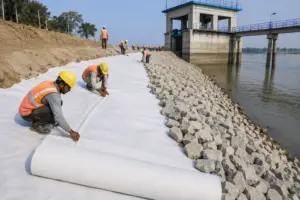
- Unroll downslope, in full contact with the soil, without stretching.
- Overlap adjacent rolls at the sides; lap the upslope roll over the downslope roll at the ends.
- Pin with steel staples or wooden or bamboo pegs, closer together on steeper slopes and in channels.
- Woven coir can also be hydroseeded after laying, because seed falls through the open mesh.
Standards
IS 15869 is the Indian specification for open weave coir bhoovastra and covers 400, 700 and 900 g/m² grades. A Ministry of Textiles quality control order requires open weave coir bhoovastra sold in India to conform to IS 15869 and carry the BIS Standard Mark, so ask for the BIS licence details when buying. Test methods for natural fibre geotextiles are in IS 15868.
Working with Ocean Geosynthetics
We work with clients on the grade, roll size and quantity for each project. Send us the slope details and area and we will recommend a coir grade. Contact us for specifications and a quote.
Frequently asked questions
How long does coir geotextile last?
Up to about five years, depending on fabric weight, climate and soil moisture. Heavier woven grades last longest.
What is coir bhoovastra?
The Indian standard term for woven coir geotextile. “Bhoovastra” means earth fabric. IS 15869 covers the open weave type.
Which GSM coir geotextile should I use?
400 GSM for gentle slopes and landscaping, 700 GSM for most embankment slopes, and 900 GSM for steep slopes, stream banks and channels with flow.
Is coir geotextile the same as a coir mat?
In erosion control, mostly yes. Woven coir geotextile and nonwoven coir mats are both sold as coir erosion mats. Woven coir is stronger; nonwoven mats give denser cover.


Related Case Studies