Jute Geotextile

Jute geotextile
Jute geotextile (JGT) is a woven or nonwoven fabric made from natural jute fibre. It does the same jobs as a synthetic geotextile (separation, filtration, drainage, surface protection), but only for a limited time, because it biodegrades. That is the point: it protects soil or a road subgrade during the period when it is most vulnerable, then breaks down once vegetation or consolidation has taken over. Ocean Geosynthetics supplies jute geotextiles for erosion control, slope protection and civil works.
Properties of jute geotextile
- Biodegradability: unlike synthetic geotextiles, untreated jute typically decomposes within 1-2 years in the soil and leaves no plastic residue. This suits temporary functions where a permanent geosynthetic is not needed. Treated (rot-resistant) jute lasts longer.
- High moisture retention: jute fibre can absorb up to about 500% of its dry weight in water (manufacturer data sheets for 500 GSM woven jute quote around 485%). On a slope this keeps the seedbed moist and helps grass establish.
- Drapability: jute softens and swells when wet, so it settles into close contact with uneven ground. Gaps under the fabric are where rills start, so good contact matters.
- Mulching effect: the fabric shades the soil and moderates soil temperature and evaporation.
- Cost: jute is grown and processed in eastern India, so jute geotextiles are often cheaper than synthetic alternatives for short-term functions.
Types of jute geotextile
Jute geotextiles come in three main forms. Tell us the application and we will confirm which we can supply for it.
- Open-weave jute (soil saver): a loose mesh with large openings, used on slopes and embankments for rainwater erosion control and vegetation. Indian practice uses three weights: 730, 500 and 292 GSM (see the jute mat specifications on our erosion control mats page).
- Woven jute geotextile: a tighter, heavier fabric with higher tensile strength, used as a separator and filter over road subgrades and behind river bank protection. It is often treated against rot to extend its life.
- Nonwoven jute: needle-punched jute felt, used where filtration or a mulch layer is needed.
Applications of jute geotextile
1. Erosion control
The most common use. Open-weave jute laid over seeded slopes, embankments and riverbanks absorbs raindrop impact, slows runoff and holds seed and topsoil in place. Slopes covered with jute geotextile lose far less soil than bare ground while vegetation establishes. By the time the jute has rotted, the roots hold the slope.
2. Road construction
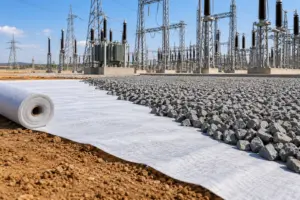
On rural and low-volume roads over soft or clayey subgrade, woven jute geotextile is placed between the subgrade and the granular sub-base. It keeps the aggregate from punching into the soil and the soil from pumping up into the aggregate, and it lets pore water drain while the subgrade consolidates under traffic. IS 14715 (Part 1) specifies woven jute geotextile for strengthening of subgrade in roads. Once the subgrade has consolidated and gained strength, the fabric is no longer needed, so its eventual decay does not matter.
3. River bank and embankment protection
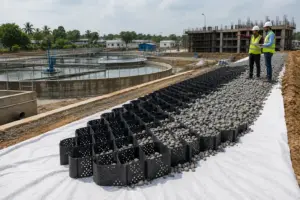
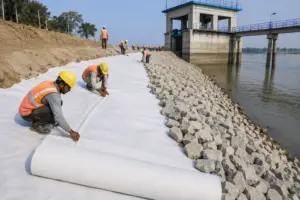
Placed under boulder pitching, concrete blocks or sand-filled bags, woven jute acts as a filter that lets water out of the bank but keeps soil from washing through the armour. IS 14715 (Part 2) covers jute geotextiles for control of bank erosion in rivers and waterways. On soft ground it also spreads load and reduces differential settlement during construction.
4. Agriculture and horticulture
Used as a biodegradable mulch mat around saplings and on nursery beds to suppress weeds and keep moisture in. It enriches the soil with organic matter as it decomposes.
5. Land reclamation
On mine dumps, degraded land and in arid and semi-arid areas, jute reduces surface runoff and improves infiltration, giving vegetation a chance to take hold. The decomposed fibre adds organic matter and supports microbial activity in the soil.
Jute or coir: how to choose
Both are natural fibres, but they behave differently. Jute absorbs more water and drapes better, and it decomposes faster. Coir geotextile is stiffer, stronger and lasts several times longer because of its high lignin content. Choose jute for gentle slopes, quick-growing grass and road subgrade separation; choose coir for steep slopes, stream banks and sites where vegetation will take longer to establish. For permanent separation, filtration or reinforcement, a synthetic geotextile is the right material.
Installation basics
- Grade and smooth the surface; remove stones and clods. Seed and fertilise before laying on slopes.
- Anchor the top end in a trench at the crest, then unroll downslope without stretching.
- Overlap adjacent rolls at the sides and lay the upslope roll over the downslope roll at the ends.
- Pin with U-shaped staples or bamboo or wooden pegs; use closer spacing on steeper slopes.
- On roads, lay woven jute flat and wrinkle-free on the prepared subgrade and place the first aggregate layer by end-tipping, without driving directly on the fabric.
Relevant Indian standards
- IS 14715 (Part 1): woven jute geotextiles for strengthening of subgrade in roads
- IS 14715 (Part 2): woven jute geotextiles for control of bank erosion in rivers and waterways
- IS 14986: guidelines for jute geotextile for rainwater erosion control in road and railway embankments and hill slopes
- IS 15868: methods of test for natural fibre geotextiles (jute and coir)
Working with Ocean Geosynthetics
- Customised supply: fabric type and weight selected for the project requirement.
- Timely delivery: supply planned around your site schedule.
- Technical support: help with product selection and application guidance.
Tell us the application, slope or road section and area, and we will recommend a jute grade. Contact us for specifications and a quote.
Frequently asked questions
How long does jute geotextile last?
Untreated jute typically decomposes within one to two years in soil, faster in warm, wet conditions. Rot-resistant treated jute lasts longer.
What GSM jute geotextile is used for erosion control?
Open-weave jute in 292, 500 or 730 GSM. Heavier grades give more cover and last longer; use them on steeper or more exposed slopes.
Can jute geotextile be used in road construction?
Yes, as a separator and filter between soft subgrade and sub-base on low-volume roads, per IS 14715 (Part 1). It is not a substitute for a synthetic geotextile or geogrid where permanent reinforcement is required.
Is jute geotextile better than coir?
Neither is better in general. Jute holds more water and costs less; coir is stronger and lasts longer. Choose by slope, flow and how long you need protection.


Related Case Studies