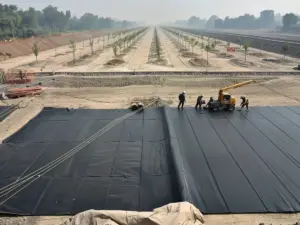
Waterproofing Sheet

Ocean Geosynthetics manufactures and supplies waterproofing sheets in HDPE, LDPE and PVC from 0.5 mm to 3 mm thick, along with waterproof membranes and geotextile-backed waterproofing mats. They are used to keep water out of foundations, basements, roofs, tanks, tunnels and bridge decks, and to keep it in reservoirs and containment areas.
Water that gets into a structure corrodes reinforcement, causes damp and mould, and leads to repairs that cost far more than the membrane would have. A polymer sheet placed on the wet side of the structure stops that water before it reaches the concrete. This page covers building and civil waterproofing; for liners in ponds, canals and landfills, see geomembrane.
Our waterproofing products
Waterproofing sheets
Our waterproofing sheets are made from polymers chosen for flexibility, tensile strength and resistance to environmental stress. Typical uses:
- Roofing systems: an impermeable layer against rain under terrace finishes and green roofs.
- Foundations: protection against groundwater under rafts and behind basement walls.
- Reservoirs and tanks: water containment without seepage.
Key specifications:
- Thickness: 0.5 mm to 3 mm
- Roll size: customizable
- Material: HDPE, LDPE and PVC
Waterproof membranes
Our waterproof membranes are made for exposure to sun, rain and temperature swings. They suit:
- Tunnels and underground structures: preventing seepage into the lining.
- Bridges and highways: protecting decks and structures against water ingress.
- Green roofs: a waterproof layer that also stops roots reaching the slab.
Features:
- UV and chemical resistance
- High puncture resistance
- Heat-welded joints for continuous coverage
Waterproofing mats
Waterproofing mats add a protective layer in areas with high moisture. Applications include:
- Landfills: helping contain leachate.
- Wetland restoration: acting as a barrier to control water flow.
- Industrial sites: protection against chemical spills.
Advantages:
- Non-woven geotextile base for added strength and puncture protection
- Controlled permeability
- Custom sizes and weights
Where a self-sealing bentonite barrier is needed, for example below a landfill liner or behind a retaining wall, see geosynthetic clay liners.
HDPE, LDPE or PVC: choosing the sheet
- HDPE: stiff, tough and resistant to chemicals and roots. Good under rafts, as a root barrier on green roofs, and in tanks holding effluent. Its stiffness makes tight corners and small details harder to form, so plan corner pieces and extrusion welds. Grades and test values are on the HDPE sheets page.
- LDPE: flexible and easy to fold. Suits damp-proofing under floor slabs, moisture barriers and simpler foundation work. See LDPE sheets.
- PVC: the most flexible of the three and easy to weld into complex shapes, which is why it is common in tunnels and on roofs. PVC must not be laid in direct contact with bitumen or polystyrene insulation, because its plasticizers migrate; separate it with a geotextile.
Where waterproofing sheets go in a structure
Under rafts and slabs
The sheet is laid on the levelling course (PCC) with welded or overlapped joints, turned up at the edges, and covered with a protective screed or board before reinforcement is fixed, so bar chairs and foot traffic do not puncture it.
Basement walls
The sheet goes on the outer face of the wall, lapped onto the raft membrane, with a dimple drain board over it. The drain board protects the sheet from backfill and relieves water pressure by carrying water down to a perimeter drain.
Roofs, terraces and podiums
On a green roof or planted podium, the sheet serves as both waterproofing and root barrier, with a drainage layer and filter geotextile above it and the growing medium on top.
Tanks, sumps and STP/ETP units
Sheets line concrete or earthen tanks to stop leakage and protect concrete from aggressive effluent. HDPE is the usual choice where the contents are chemically aggressive.
Tunnels and cut-and-cover structures
A welded thermoplastic membrane is fixed over a geotextile fleece between the primary and final linings. The fleece cushions the membrane against rough shotcrete and carries water to the drains.
Installation checks
- Surface clean, dry and free of sharp projections; round off internal corners with a fillet.
- Joints heat-welded (HDPE, LDPE, PVC) and tested: air pressure for double-track wedge welds, vacuum box for extrusion welds.
- Pipe penetrations sealed with prefabricated boots or welded collars.
- Sheet protected immediately with screed, board or drain board; never left exposed under reinforcement work or backfill.
Applications across sectors
- Agriculture: irrigation channels and ponds.
- Industrial: storage tanks and containment areas.
- Residential: dry basements and leak-proof bathrooms.
For an example, see our waterproofing project in Dwarka, Delhi, or browse more case studies.
Why Ocean Geosynthetics
- Custom thicknesses, roll sizes and material choice for each project
- Products tested against ASTM methods
- A technical team for support on material choice and installation
- Competitive pricing
Frequently asked questions
Which waterproofing sheet should I use for a basement?
HDPE sheet under the raft and on the walls, with welded joints and a dimple drain board for protection, suits most basements with a high water table. LDPE is enough for damp-proofing where groundwater stays below the slab.
What thickness should I use?
Thinner sheets (around 0.5 mm) are used as moisture barriers; foundations, tanks and roofs under heavier loads or water pressure usually take 1 mm or more. Base the choice on water pressure, the risk of damage during construction and the design life.
Can waterproofing sheets be used on terraces?
Yes, under a protective screed, tiles or a green-roof build-up. Exposed sheet on a terrace needs a UV-resistant grade.
How are the joints sealed?
HDPE, LDPE and PVC sheets are heat-welded on site, which fuses the two sheets into one. Welds are then tested before the sheet is covered.
Discuss your waterproofing project
Tell us the structure, water conditions and area, and we will recommend a sheet, membrane or mat and send a quote.


Related Case Studies