Geo Bags

Ocean Geosynthetics manufactures geo bags (geotextile sand containers) for riverbank protection, flood control, coastal erosion work and scour protection. Our standard bags are needle-punched nonwoven geotextile in polypropylene (PP) or polyester (PET), in 300 GSM and 400 GSM, with a bag size of 1.03 × 0.70 m. Custom sizes and grades are available. This page covers how geo bags work, how to choose a grade, and how they are filled and placed. For pricing factors, see our article on geo bag uses and prices.
Table of Contents
What are geo bags?
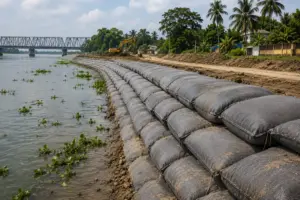
Geo bags are bags sewn from geotextile and filled with sand on or near site. They are also called geotextile sand containers (GSC) or geobags. Once filled and sewn shut, each bag is a heavy, flexible unit that can be stacked like blocks to build revetments, aprons, groynes and bunds, either in the dry or under water.
They work because of three properties of the geotextile:
- Weight with flexibility: a filled bag is heavy enough to resist being moved by currents and waves, yet soft enough to settle and follow the bank as it changes shape. Because the bags are soft armour, they do not crack the way concrete blocks do.
- Filtration: water passes through the fabric but the sand stays inside. On a riverbank, this lets pore water drain out of the bank without washing soil with it.
- Abrasion and puncture resistance: the needle-punched nonwoven fabric withstands handling, dumping and contact with debris carried by the river.
Geo bags are used where hard armour (boulders, concrete blocks) is expensive or unavailable, or where sand is available locally. They can also be removed later, which makes them suitable for temporary bunds and cofferdams.
Types of geo bags Ocean supplies
Depending on the geotextile used, geo bags can be woven or nonwoven:
- Nonwoven polypropylene (PP) geo bags: needle-punched PP, 300 GSM and 400 GSM. PP is lighter than polyester and resists a wide range of chemical conditions.
- Nonwoven polyester (PET) geo bags: needle-punched PET, 300 GSM and 400 GSM. Polyester has higher resistance to creep under sustained load.
- Woven multifilament geo bags: made from woven fabric, with higher tensile strength and lower elongation than nonwoven fabric of the same weight.
The nonwoven grades are listed in IS 16653:2017, the BIS specification for needle-punched nonwoven geobags for coastal and waterways protection. The specification tables below give Ocean’s tested values.
Technical Specifications
Nonwoven Geobags (PP)
| Property | Unit | Test Method | 300 GSM | 400 GSM |
|---|---|---|---|---|
| Bag Dimension | M | IN-HOUSE | 1.03 x 0.70 | 1.03 x 0.70 |
| Mass Per Unit Area | GSM | ASTM D5261 | 300 | 400 |
| Thickness at 2 KPA | MM | ASTM D5199 | 2.58 | 3.05 |
| Type of Geotextile | – | IS 16653:2017 | 100% PP | 100% PP |
| Wide Tensile Strength | KN/M | ASTM D4595 | 17.8 | ≥20 |
| Elongation | % | ASTM D4595 | 64.7 | ≥55 |
| Trapezoidal Tear Strength | N | ASTM D4533 | 460.8 | ≥472 |
| CBR Puncture Strength | N | ASTM D6241 | 2950 | 4050 |
| Permittivity | S-1 | ASTM D4491 | 0.8 | 1.1 |
| Permeability | L/M2/S | ASTM D4491 | 40 | 45 |
| Apparent Opening Size | µM | ASTM D4751 | 75 | 75 |
| UV Resistance @500 Hrs | % | ASTM D4355 | 80 | 80 |
Nonwoven Geobags (PET)
| Property | Unit | Test Method | 300 GSM | 400 GSM |
|---|---|---|---|---|
| Bag Dimension | M | IN-HOUSE | 1.03 x 0.70 | 1.03 x 0.70 |
| Mass Per Unit Area | GSM | ASTM D5261 | ≥300 | ≥400 |
| Thickness at 2 KPA | MM | ASTM D5199 | ≥3 | ≥3 |
| Type of Geotextile | – | IS 16653:2017 | 100% PET | 100% PET |
| Wide Tensile Strength | KN/M | ASTM D4595 | ≥15 | ≥20 |
| Elongation | % | ASTM D4595 | ≥50 | ≥50 |
| Trapezoidal Tear Strength | N | ASTM D4533 | ≥340 | ≥450 |
| CBR Puncture Strength | N | ASTM D6241 | ≥3000 | ≥4000 |
| Permittivity | S-1 | ASTM D4491 | ≥1.25 | ≥1.10 |
| Permeability | L/M2/S | ASTM D4491 | ≥60 | ≥40 |
| Apparent Opening Size | µM | ASTM D4751 | ≤75 | ≤75 |
| UV Resistance @500 Hrs | % | ASTM D4355 | ≥80 | ≥80 |
Key Applications
- Riverbank stabilization and coastal erosion protection
- Flood embankments and temporary flood barriers
- Urban flood defense and emergency disaster response
- Coastal defense structures and port/harbor protection
- Canal lining and wetland restoration
- Embankment and levee construction
- Slope stabilization for highways and railways
- Foundation support for hydraulic structures
Key Features
- High filtration efficiency that passes water while retaining soil particles
- Excellent durability with resistance to UV, chemicals and biological degradation
- Superior flexibility that conforms to complex site geometries and ground movement
- Rapid installation as bags are lightweight and easy to handle
- Cost-effective alternative to traditional hard armor systems
- High load-bearing capacity for embankments and retaining walls
- Superior dimensional stability under varying loads
Key properties and how they are tested
- Mass per unit area (ASTM D5261): the fabric weight in GSM. Higher GSM generally means higher puncture and tear resistance.
- Wide-width tensile strength and elongation (ASTM D4595): how much load the fabric carries before failure. High elongation in nonwoven fabric helps the bag absorb impact during dumping.
- Trapezoidal tear strength (ASTM D4533) and CBR puncture strength (ASTM D6241): resistance to tearing from a cut or snag and to puncture by stones or debris.
- Permittivity and permeability (ASTM D4491): how readily water passes through the fabric.
- Apparent opening size, AOS (ASTM D4751): the effective pore size. A small AOS (75 µm for Ocean’s bags) retains fine river sand.
- UV resistance (ASTM D4355): strength retained after 500 hours of accelerated UV exposure.
Seam strength matters as much as fabric strength, because a bag usually fails at the seam. Ask for the seam type and seam efficiency along with the fabric data.
Applications
- Riverbank protection: revetments on eroding banks, often with a launching apron of bags at the toe that settles into scour holes as they form. Ocean geobags were used to protect the flood-prone banks at Chhapra, Bihar, and for riverbank and irrigation work in Howrah, West Bengal.
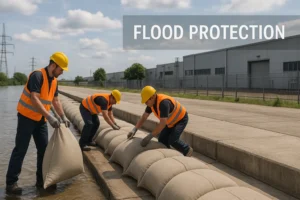
- Flood protection: raising and strengthening embankments and building temporary flood barriers; see our article on the role of geobags and gabions in flood protection.
- Coastal protection: seawalls, revetments, offshore breakwaters and beach protection. When used in groynes, they slow the current and allow sand to accrete.
- Scour protection around bridge piers, abutments and other hydraulic structures.
- Levees and embankment cores: geotextile bags filled with clay slurry can form the core of levees.
- Dams and reservoirs: slope and toe protection, as in the Bambolim Dam project in Goa with PET geobags.
- Ports and mines: bunds, reclamation edges and temporary containment.
- Temporary works: cofferdams and diversion bunds that can be removed when the job is done.
Geo bags are used across transportation, water resources, irrigation and flood control, ports and mining projects. More on their environmental uses is in our article on geobags in environmental engineering.
Geo bags are not the same as dewatering bags. Dewatering of slurry and sludge is done with large containers made from woven dewatering fabric; see geo tube dewatering containers.
How to choose a geo bag
- 300 GSM vs 400 GSM: 300 GSM suits bank revetments placed by hand in the dry or in calm water. Choose 400 GSM where bags are dumped from a barge or from height, where the river carries debris, or where waves and strong currents will abrade the fabric.
- PP vs PET: both are used for river and coastal work. PET offers better creep resistance under sustained load; PP is lighter and is generally preferred in strongly alkaline conditions, where polyester can lose strength by hydrolysis.
- Bag size: the 1.03 × 0.70 m bag is a common size in Indian river protection tenders, typically specified with a minimum fill of 126 kg of sand. Larger bags are more stable in strong currents but need cranes or barges to place.
- Fill material: clean sand or silty sand, free of sharp stones and debris. The AOS of the fabric must be fine enough to retain the fill.
- Certification: IS 16653 is a mandatory certification product under BIS, so check the BIS licence details when comparing suppliers.
Filling and placement
- Fill bags with sand, typically to around 80% of their capacity, so that the bag can flatten and interlock with neighbouring bags instead of rolling.
- Close the mouth by sewing with a portable bag-closing machine and UV-stabilised PP or polyester thread.
- In the dry, place bags by hand in staggered courses, like brickwork, with the long side in the direction specified by the design, and lay a nonwoven geotextile filter on the prepared bank behind the bags where required.
- Under water, bags are dumped from a pontoon or barge at surveyed positions. Check placement by sounding, as bags can drift in current.
- Exposed bags lose strength under sunlight over time. Cover bags above water level with soil or vegetation where practical, and plan inspection after each monsoon.
Related products
- Gabion boxes and mattresses: stone-filled wire mesh for revetments and river training; bags can also be placed inside PVC-coated wire boxes.
- Geotextiles: filter layer beneath geo bag revetments.
- Geo tubes: large hydraulically filled containers for coastal structures, reclamation and dewatering.
- Natural-fibre options for vegetated bank protection: jute geotextile and coir geotextile.
Frequently asked questions
What is a geo bag made of?
Ocean’s geo bags are made from needle-punched nonwoven geotextile in polypropylene or polyester, in 300 GSM and 400 GSM. Woven multifilament bags are also available.
What size are geo bags?
The standard Ocean bag is 1.03 × 0.70 m. This size is common in Indian river protection works and is usually specified to hold at least 126 kg of sand. Other sizes are made to order.
Which Indian standard covers geo bags?
IS 16653:2017 specifies needle-punched nonwoven geobags for coastal and waterways protection.
How much sand goes into a geo bag?
Bags are typically filled to about 80% of capacity. For the 1.03 × 0.70 m size, tenders commonly specify a minimum of 126 kg of sand per bag.
Can geo bags be placed under water?
Yes. Filled and sewn bags can be dumped from a barge or pontoon to form underwater aprons and toe protection. Placement should be checked by sounding.
How long do geo bags last?
Life depends mainly on sunlight exposure and abrasion. Bags that stay submerged or covered last far longer than bags left exposed to sun above the water line, so cover exposed bags where possible.


Related Case Studies